
近日,《Geoscience Frontiers》期刊发表了题为《Probing multi-physical process and deformation mechanism of a large-scale landslide using integrated dual-source monitoring》的论文。该研究由朱鸿鹄教授、叶霄博士、裴华富教授、张巍副教授、程刚教授和李孜理副教授等学者共同完成。他们分别来自南京大学地球科学与工程学院、大连理工大学岩土工程系、爱尔兰科克大学工程与建筑学院、美国麻省理工学院土木与环境工程系。
文章介绍了一种经济高效的双源综合监测系统,用于实时监测滑坡的多物理过程,以更好地理解滑坡的变形机制。研究发现,深层滑动面主要受到极端降雨的影响,而浅层滑动面则受到水库水位变化和降雨的共同驱动。该研究为滑坡防治和工程措施的改进提供了新的思路和依据。
论文研究亮点包括:
1. 实现了基于多个关键钻孔的滑坡双源多物理场综合监测
2. 成功识别了以渗流驱动或浮力驱动的混合行为
3. 揭示桩土之间的间隙加剧了雨水的侵蚀效应
01 研究背景
滑坡是三峡库区常见的地质灾害,尤其是水库的建设与运行重新激活了大量的古滑坡,这些滑坡可能给下游地区带来巨大的安全隐患。传统的监测系统往往成本高昂,且难以同时获取多种关键的物理参数,限制了地质灾害监测的精度和效率。为此,论文提出了一种整合了光纤布拉格光栅(FBG)和微机电系统(MEMS)的双源监测系统,旨在提供一种经济高效的滑坡监测解决方案。
02 研究方法
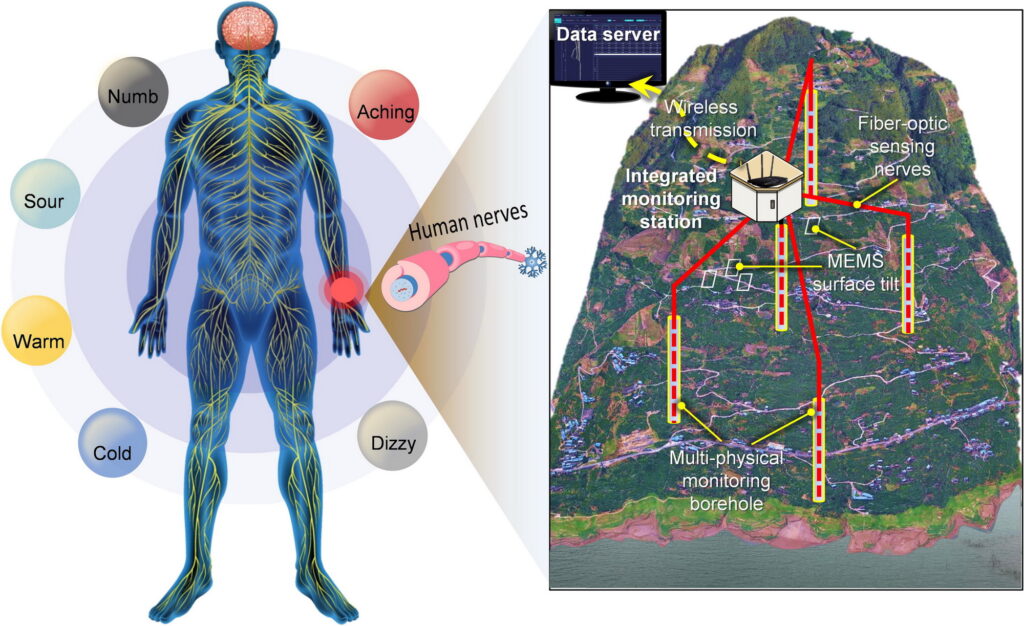
论文中开发了一种新型的双源监测系统,该系统结合了FBG和MEMS技术,可以同时监测土壤的湿度、温度、应变、滑动阻力、表面倾斜和深层倾斜等多种物理参数。监测设备被布置在新铺滑坡的多个关键位置,特别是滑坡前缘的活跃区域,进行长期的现场监测。数据通过无线传输到在线平台进行实时分析,以捕捉滑坡的动态行为及其影响因素。
1、综合多物理场监测系统
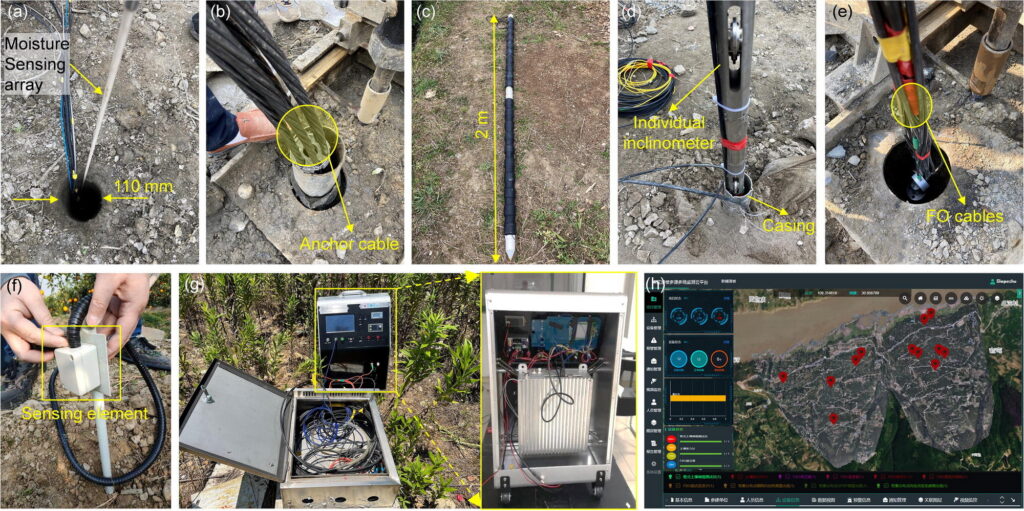
鉴于滑坡的随机性,建立具有实时功能的多物理场监测系统至关重要。文章首次开发了一种新型多物理场监测系统,该系统集成了FBG和MEMS传感技术,用于监测土壤湿度、温度、表面倾斜、深层倾斜、应变和滑动阻力。该集成监测设备由两个微型数据采集单元(即FBG和MEMS)、一个微处理器、一个控制器、一个无线传输单元和一组高容量太阳能电池。它可以留在现场管理多个钻孔的数据采集。记录的数据被传输到在线数据平台,可以实时访问、下载和重新处理,采样频率可从5秒到10分钟、1小时或根据需要调整。
2、FBG和MEMS技术
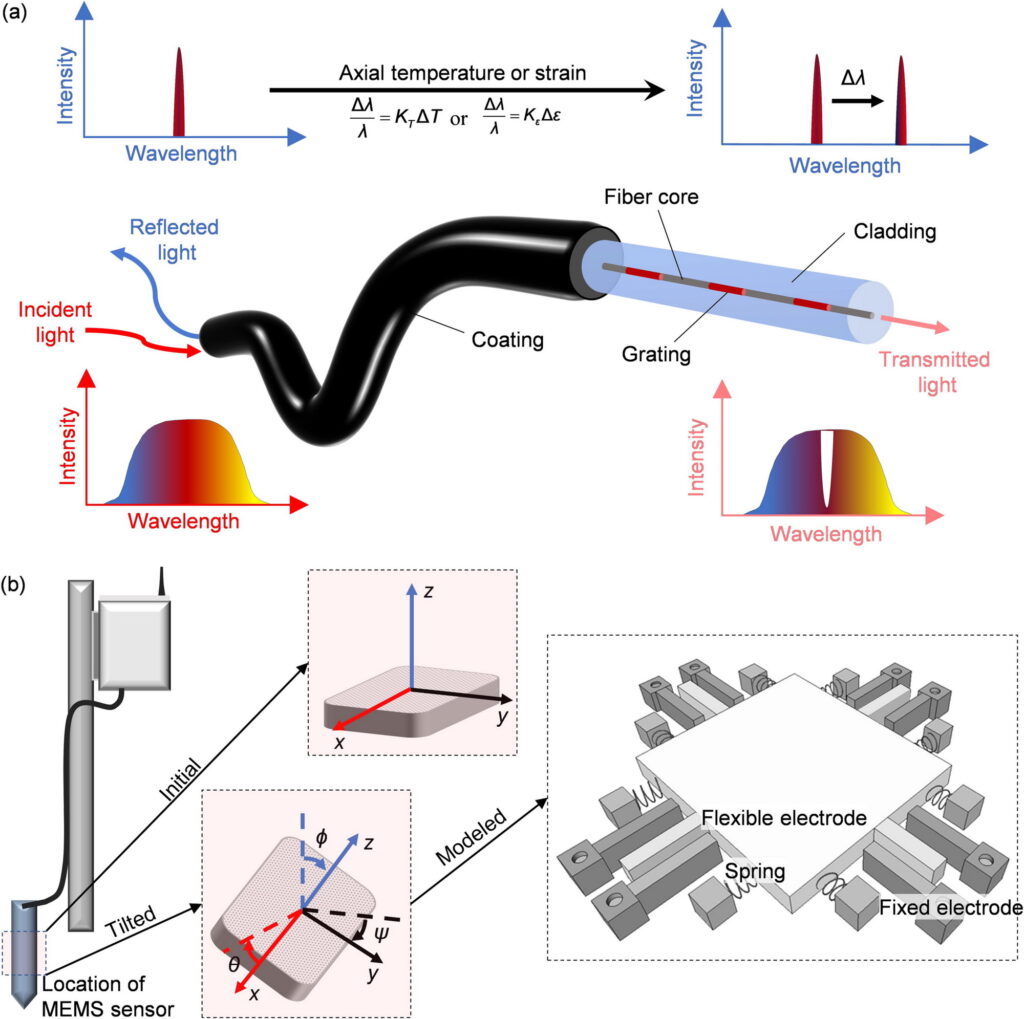
研究中采用的FBG技术是一种光纤传感技术,通过反射特定波长的光来测量外部应力和温度变化。MEMS是一种微型集成系统,包含微控制器单元(MCU)、加速度计、模拟-数字转换电路(ADC)和通信单元等组件。MEMS倾角传感器能够测量地表和深层的倾斜变化,用于捕捉滑坡的预失稳行为。
3、现场调查与设备安装
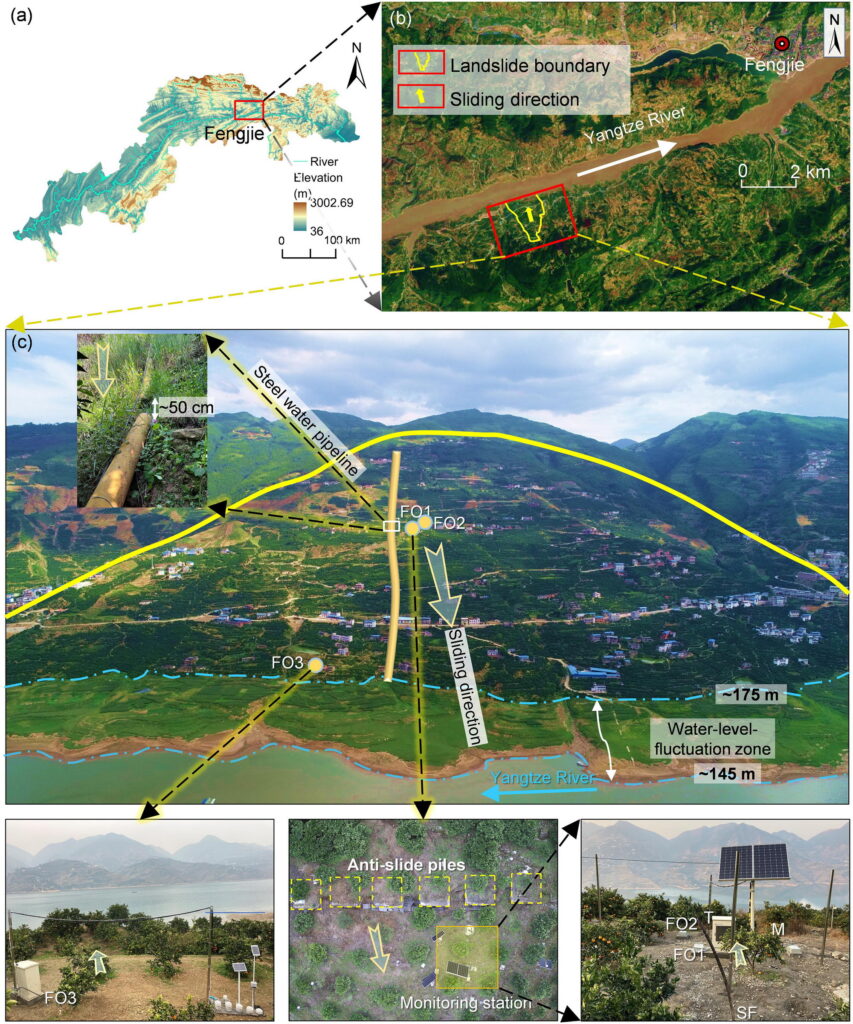
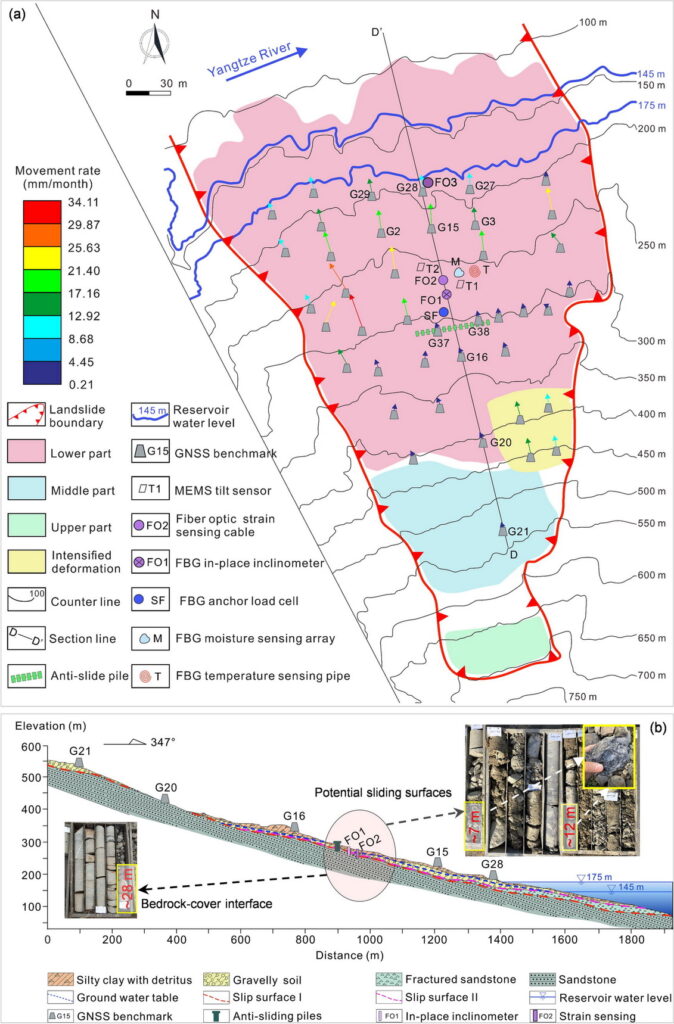
新铺滑坡位于三峡库区,是一处活跃的超大型滑坡,滑坡体积达到5.4×10⁷立方米,平均坡度为15°-20°。滑坡主要滑动方向几乎垂直于长江,滑坡前缘常年被水库水位淹没。研究区域内滑坡的前缘是最活跃的区域,因而被选择作为主要监测点。
03研究结果
1、土壤水分场
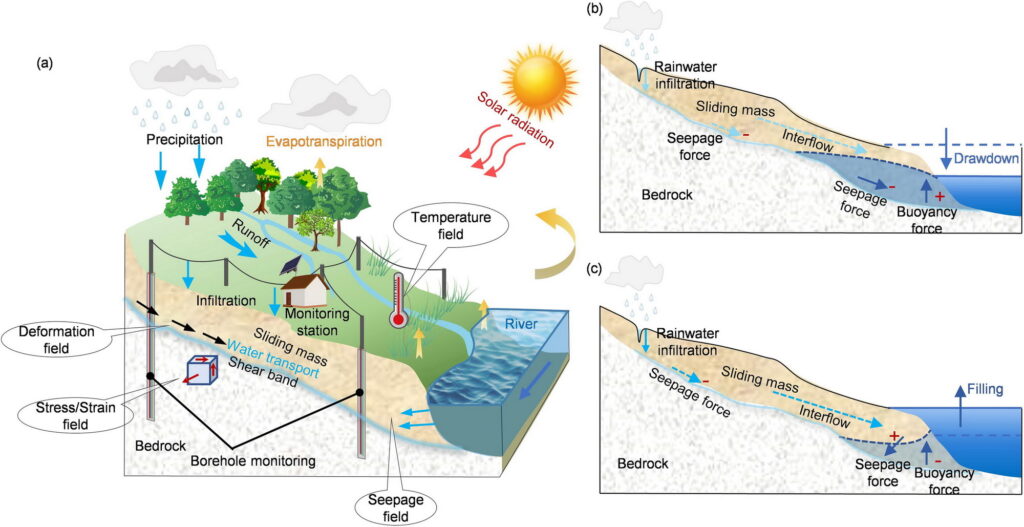
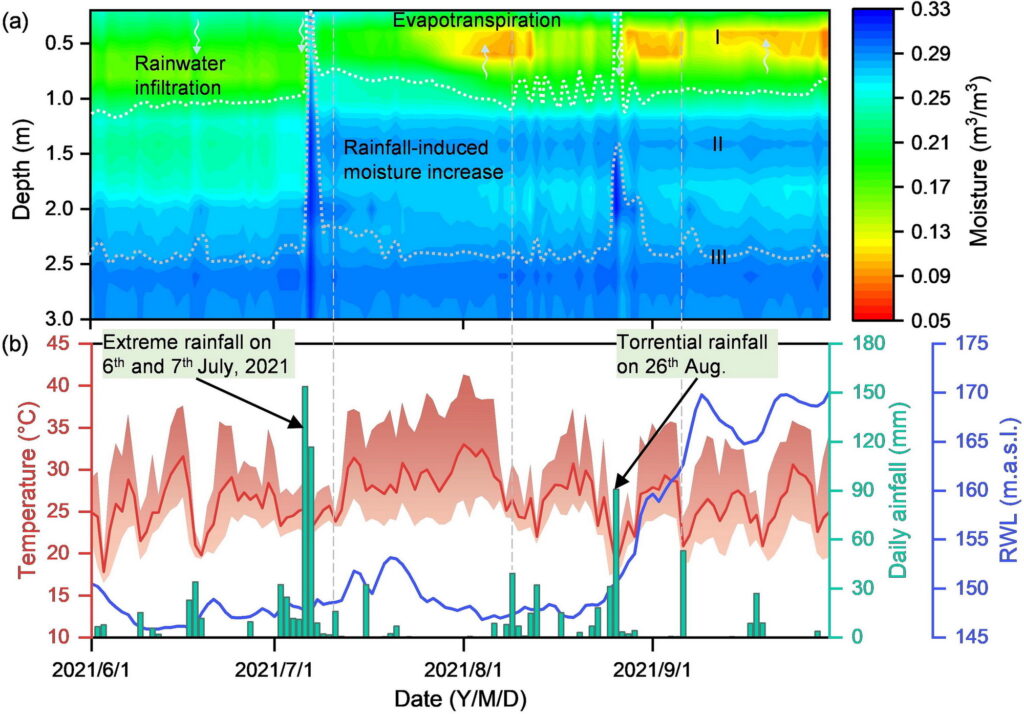
文章通过监测土壤的湿度变化,分析了降雨事件对滑坡体内水分迁移的影响。监测结果表明,土壤湿度随深度的变化可分为三个主要区域:高度活跃的水分迁移区(0-1.0m)、较低含水率区(1.0-2.4m)和较高含水率区(2.4-3.0m)。在较浅层的区域,土壤湿度与降雨事件有良好的对应关系,反映了降雨渗透过程的动态变化。而在较深的区域,土壤湿度受气象条件的影响较小,反映了不同土层之间的渗透条件差异。
2、应力场
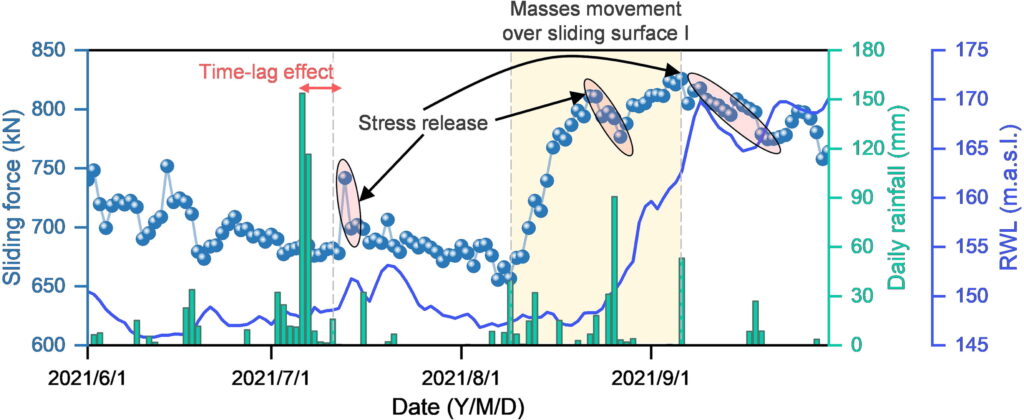
滑动阻力的监测采用了锚固电缆,通过轴向应力的变化来指示滑动体在水平位移过程中滑动阻力的变化。监测显示,在降雨高峰期后,滑动阻力显著增加,随后由于变形导致的应力释放,滑动阻力迅速下降。特别是持续的降雨事件和水库水位的波动对滑动阻力有显著影响,这些现象表明滑坡的运动具有滞后效应,即降雨后的地下变形并不会立即发生,而是随着时间的推移逐渐显现。
3、温度场
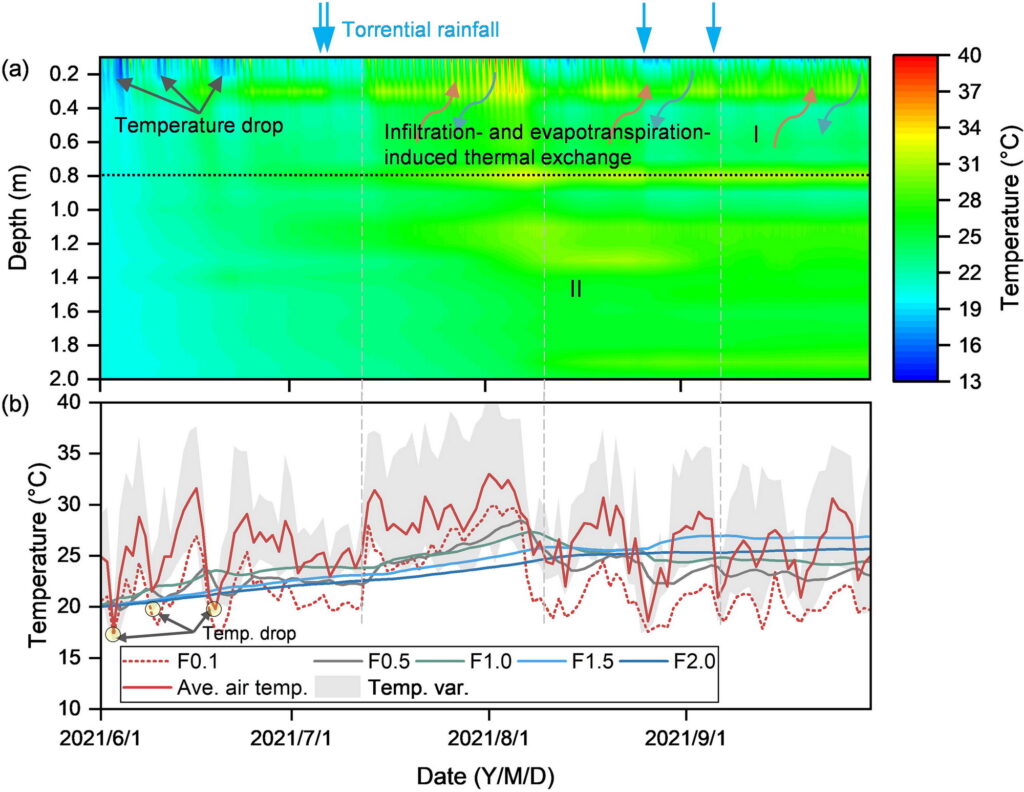
温度监测结果表明,土壤温度在0.8米深度处有明显的分界线,该深度以上的土壤温度对气象条件的响应更加敏感,而深层土壤温度则变化平缓。土壤温度的变化与土壤湿度的变化密切相关,揭示了温度对滑坡稳定性潜在的影响。
4、位移场
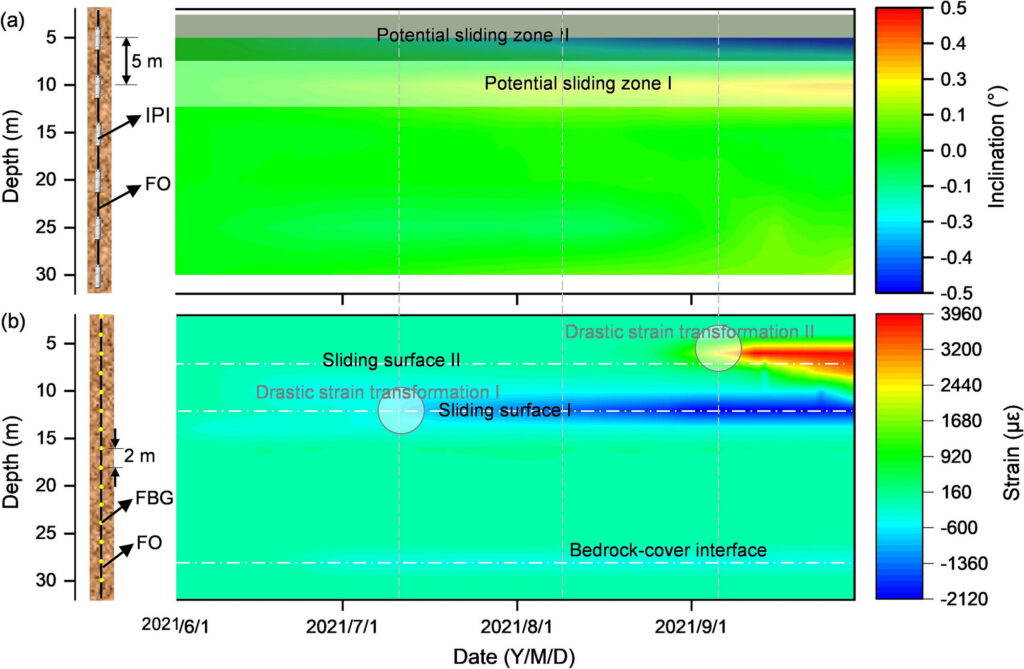
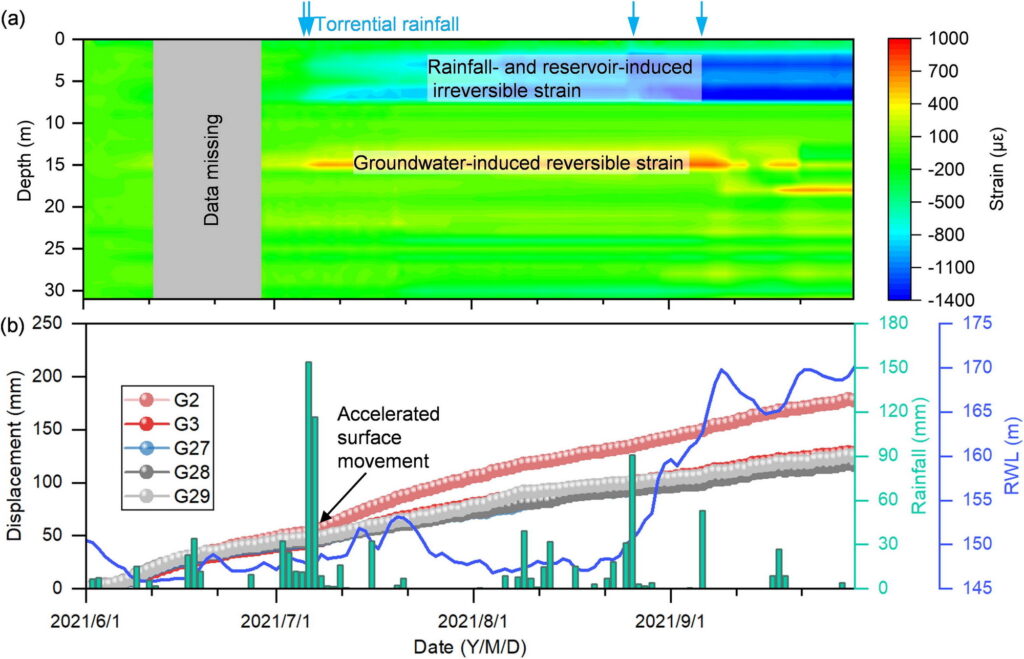
在变形监测中,使用了光纤布拉格光栅(FBG)和微机电系统(MEMS)传感器记录滑坡体内的应变和倾斜变化。监测揭示了两个显著的应变峰值区域,分别位于7米和12米深度,确定了滑动面的具体位置。深层滑动面(约28米深处)在整个汛期内仅表现出轻微变形。在2021年7月6日的大雨后,滑坡体的应变数据出现了明显的压缩应变,表明降雨引发的地下变形具有滞后效应。这一现象说明了滑坡的水文和力学过程对表层水分平衡的短期变化不敏感,并且对降雨事件的响应可能会滞后数天甚至数月。
5、地表和地下动力学分析
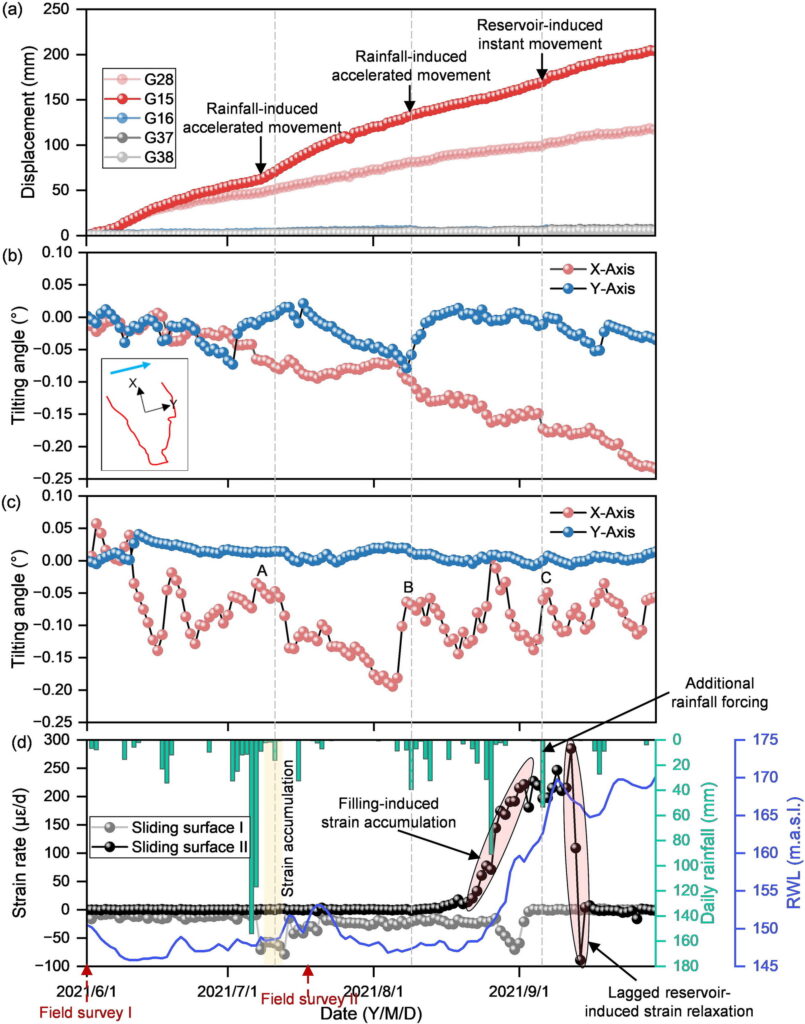
监测还包括对滑坡表面和地下的动态行为分析。通过GNSS标记和MEMS倾斜传感器的数据,显示出地表位移与地下应变的相互关系。分析表明,滑坡下部区域的变形主要由雨水渗透引起,而上部区域则受水库水位波动的影响。尤其是防滑桩前的土壤发生了显著的变形,而防滑桩后的区域则相对稳定。此外,文章通过对滑动面的应变速率、表面位移和倾斜角度的时间序列分析,发现了多个关键的变形加速点。这些加速点主要与极端降雨和水库水位的剧烈变化相关。
在滑坡前缘的浅层土壤中,雨水渗透引起了有效应力的降低,导致滑坡体在汛期内发生了较小幅度的蠕变。而深层的变形则表现为应变的累积和释放,表明动态地下水的作用。总体而言,浅层土壤的蠕变与滑坡前缘的表面位移趋势一致,反映了滑坡前缘区域的慢速蠕变行为。
6、现场宏观变形
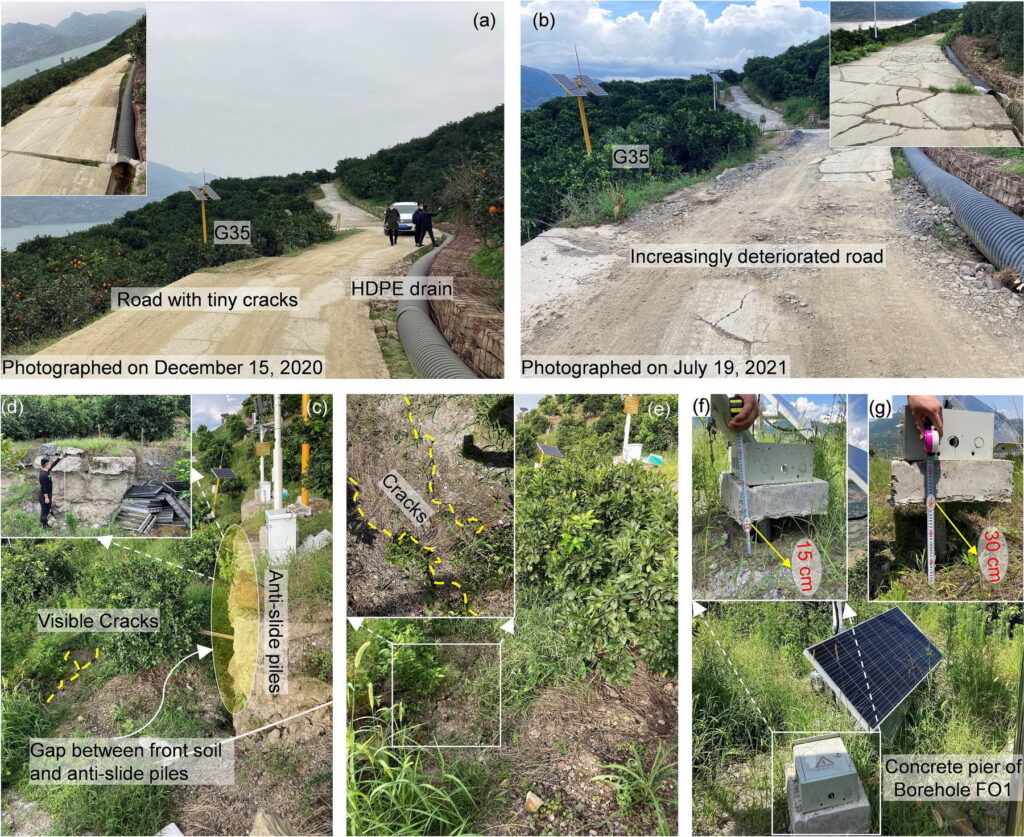
作者通过现场调查验证了监测结果,发现大量道路裂缝和地面沉降现象,尤其是在防滑桩前的区域。这些现场证据与监测数据高度一致,进一步验证了滑坡体的加速变形过程。
7、新铺滑坡前缘变形机制
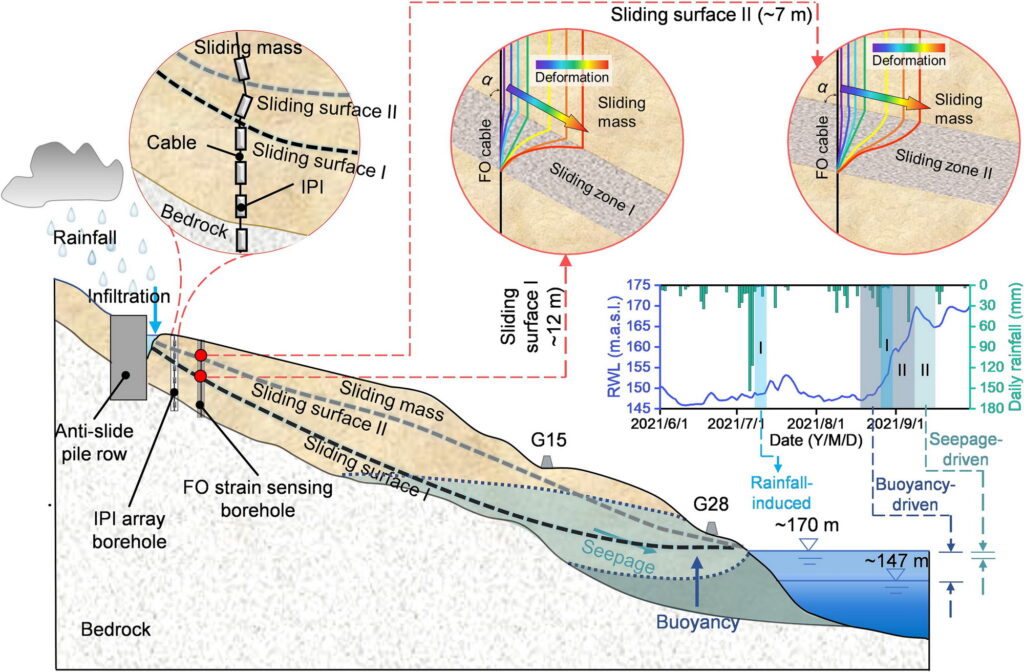
研究表明,在滑坡前缘的浅层土壤中,雨水渗透引起了有效应力的降低,导致滑坡体在汛期内发生了较小幅度的蠕变。而深层的变形则表现为应变的累积和释放,表明动态地下水的作用。总体而言,浅层土壤的蠕变与滑坡前缘的表面位移趋势一致,反映了滑坡前缘区域的慢速蠕变行为。
04研究创新
1、技术整合的创新
文章首次将FBG与MEMS技术整合应用于滑坡监测,开发出了一种双源监测系统。传统的监测技术往往单独使用某一类型的传感器,存在监测参数单一、空间分辨率有限等问题。而本文提出的双源监测系统能够同时监测多种物理参数,包括土壤湿度、温度、滑动阻力、应变、表面位移和深部位移,这在滑坡监测领域具有显著的技术创新性。
2、滑坡变形机制的深入揭示
通过对三峡库区新浦滑坡的具体监测,揭示了滑坡体内多层滑动面和复杂的变形机制,为滑坡防治工程提供了理论支持。
05研究意义
1、提供了经济高效的滑坡监测解决方案
文章提出的双源监测系统将FBG和MEMS技术相结合,能够以较低的成本实现多种物理参数的实时监测。这种经济高效的监测方法,不仅可以大幅降低地质灾害监测的成本,还能提高数据的精度和可靠性,为大规模滑坡的长期监测提供了实用的技术手段。
2、提升了地质灾害监测的综合能力
该研究大大提高了对滑坡多物理场的监测能力,并实现数据的实时传输和处理。这样的综合监测能力有助于全面捕捉滑坡的动态行为及其演变过程,提升了地质灾害预警和风险管理的水平。
3、为滑坡防治工程提供了科学依据
研究发现,抗滑桩在控制滑坡后部变形方面有效,但对滑坡前缘的防治效果有限。尤其是防滑桩与土体之间的界面容易成为雨水侵蚀的路径,加剧了滑坡的变形。通过这些监测数据,为滑坡防治工程的优化设计提供了重要的参考,有助于提高工程措施的针对性和有效性,减少地质灾害对人类生命财产的威胁。
Probing multi-physical process and deformation mechanism of a large-scale landslide using integrated dual-source monitoring
Hong-Hu Zhu, Xiao Ye, Hua-Fu Pei, Wei Zhang, Gang Cheng, Zi-Li Li
https://doi.org/10.1016/j.gsf.2023.101773
ABSTRACT: The implementation of isolated heterologous monitoring systems for spatially distant borehole deployments often comes with substantial equipment costs, which can limit the effectiveness of geohazard mitigation and georisk management efforts. To address this, we have developed a novel monitoring system that integrates fiber Bragg grating (FBG) and microelectromechanical system (MEMS) techniques to capture soil moisture, temperature, sliding resistance, strain, surface tilt, and deep-seated inclination. This system enables real-time, simultaneous data acquisition and cross-validation analyses, offering a cost-effective solution for monitoring critical parameters in geohazard-prone areas. We successfully applied this integrated monitoring system to the Xinpu landslide, an active super-large landslide located in the Three Gorges Reservoir Area (TGRA) of China. The resulting strain profile confirmed the presence of two shallow secondary sliding surfaces at depths of approximately 7 m and 12 m, respectively, in addition to the deep-seated sliding surface at a depth of ∼28 m. The lower secondary sliding surface was activated by extreme precipitation, while the upper one was primarily driven by significant changes in reservoir water levels and secondarily triggered by concentrated rainfalls. Anti-slide piles have remarkably reinforced the upper moving masses but failed to control the lower ones. The gap between the pile heads and the soil amplified the rainwater erosion effect, creating a preferential channel for rainwater infiltration. Multi-physical measurements revealed a mixture of seepage-driven and buoyancy-driven behaviors within the landslide. This study offers an integrated dual-source multi-physical monitoring paradigm that enables collaborative management of multiple crucial boreholes on a large-scale landslide, and contributes to the evaluation and improvement of engineering measures in similar geological settings.
References
Acharya, A., Kogure, T., 2023. Application of novel distributed fibre-optic sensing for slope deformation monitoring: a comprehensive review. Int. J. Environ. Sci. Technol. 20, 8217–8240. https://doi.org/10.1007/s13762-022-04697-5.
AghaKouchak, A., Huning, L.S., Chiang, F., Sadegh, M., Vahedifard, F., Mazdiyasni, O., Moftakhari, H., Mallakpour, I., 2018. How do natural hazards cascade to cause disasters? Nature 561, 458–460. https://doi.org/10.1038/d41586-018-06783-6.
Berti, M., Simoni, A., 2010. Field evidence of pore pressure diffusion in clayey soils prone to landsliding. J. Geophys. Res. Earth Surf. 115, F03031. https://doi.org/10.1029/2009JF001463.
Chen, M.L., Yang, X.G., Zhou, J.W., 2022. Spatial distribution and failure mechanism of water-induced landslides in the reservoir areas of Southwest China. J. Rock Mech. Geotech. Eng. 15 (2), 442–456. https://doi.org/10.1016/j.jrmge.2022.04.004.
Fang, K., Tang, H.M., Li, C.D., Su, X.X., An, P.J., Sun, S.X., 2023a. Centrifuge modelling of landslides and landslide hazard mitigation: A review. Geosci. Front. 14, (1). https://doi.org/10.1016/j.gsf.2022.101493 101493.
Fang, K., Zhang, J.F., Tang, H.M., Hu, X.L., Yuan, H.H., Wang, X.T., An, P.J., Ding, B.D.,
2023b. A quick and low-cost smartphone photogrammetry method for obtaining 3D particle size and shape. Eng. Geol. 322,. https://doi.org/10.1016/j.enggeo.2023.107170 107170.
Ferrari, A., Ledesma, A., González, D.A., Corominas, J., 2011. Effects of the foot evolution on the behaviour of slow-moving landslides. Eng. Geol. 117, 217–218. https://doi.org/10.1016/j.enggeo.2010.11.001.
Finnegan, N.J., Perkins, J.P., Nereson, A.L., Handwerger, A.L., 2021. Unsaturated flow
processes and the onset of seasonal deformation in slow-moving landslides. J. Geophys. Res. Earth Surf. 126, e2020JF005758. doi: 10.1029/2020JF005758.
Gariano, S.L., Guzzetti, F., 2016. Landslides in a changing climate. Earth-Sci. Rev.
162, 227–252. https://doi.org/10.1016/j.earscirev.2016.08.011.
Guo, J.Y., Shi, B., Sun, M.Y., Zhang, C.C., Tang, C.S., Wei, G.Q., Fang, J.H., Jiang, H.T.,
2023. Soil total suction sensing using fiber-optic technology. Geoderma 439.
https://doi.org/10.1016/j.geoderma.2023.116687 116687.
Ho, Y.T., Huang, A.B., Lee, J.T., 2006. Development of a fibre Bragg grating sensored
ground movement monitoring system. Meas. Sci. Technol. 17, 1733–1740.
https://doi.org/10.1088/0957-0233/17/7/011.
Hu, X., Bürgmann, R., Schulz, W.H., Fielding, E.J., 2020. Four-dimensional surface motions of the Slumgullion landslide and quantification of hydrometeorological forcing. Nat. Commun. 11, 2792. https://doi.org/10.1038/s41467-020-16617-7.
Hu, X.L., Liu, D.Z., Niu, L.F., Liu, C., Wang, X., Fu, R., 2021. Development of soil-pile
interactions and failure mechanisms in a pile-reinforced landslide. Eng. Geol. 294. https://doi.org/10.1016/j.enggeo.2021.106389 106389.
Huang, X.H., Guo, F., Deng, M.L., Yi, W., Huang, H.F., 2020. Understanding the deformation mechanism and threshold reservoir level of the floating weightreducing landslide in the Three Gorges Reservoir Area, China. Landslides 17, 2879–2894. https://doi.org/10.1007/s10346-020-01435-1.
Hurley, D.G., Pantelis, G., 1985. Unsaturated and saturated flow through a thin porous layer on a hillslope. Water Resour. Res. 21, 821–824. https://doi.org/10.1029/WR021i006p00821.
Jones, J.N., Boulton, S.J., Bennett, G.L., Stokes, M., Whitworth, M.R.Z., 2021. Temporal variations in landslide distributions following extreme events: Implications for landslide susceptibility modeling. J. Geophys. Res. Earth Surf. 126, e2021JF006067. doi: 10.1029/2021JF006067.
Kogure, T., Okuda, Y., 2018. Monitoring the vertical distribution of rainfall-induced strain changes in a landslide measured by distributed fiber optic sensing with Rayleigh backscattering. Geophys. Res. Lett. 45, 4033–4040. https://doi.org/10.1029/2018GL077607.
Lacroix, P., Handwerger, A.L., Bièvre, G., 2020. Life and death of slow-moving landslides. Nat. Rev. Earth Environ. 8, 1–419. https://doi.org/10.1038/s43017-020-0072-8.
Lehmann, P., Or, D., 2012. Hydromechanical triggering of landslides: From progressive local failures to mass release. Water Resour. Res. 48, W03535.https://doi.org/10.1029/2011WR010947.
Leshchinsky, B., Olsen, M.J., Mohney, C., O’Banion, M., Bunn, M., Allan, J., McClung,
R., 2019. Quantifying the sensitivity of progressive landslide movements to failure geometry, undercutting processes and hydrological changes. J. Geophys. Res. Earth Surf. 124, 616–638. https://doi.org/10.1029/2018JF004833.
Li, Y., Utili, S., Milledge, D., Chen, L.X., Yin, K.L., 2021. Chasing a complete understanding of the failure mechanisms and potential hazards of the slow moving Liangshuijing landslide. Eng. Geol. 281,. https://doi.org/10.1016/j.enggeo.2020.105977 105977.
Liu, Y., Xu, C., Huang, B., Ren, X.W., Liu, C.Q., Hu, B.D., Chen, Z., 2020. Landslide
displacement prediction based on multi-source data fusion and sensitivity states. Eng. Geol. 271,. https://doi.org/10.1016/j.enggeo.2020.105608 105608.
Ma, J.W., Tang, H.M., Liu, X., Hu, X.L., Sun, M.J., Song, Y.J., 2017. Establishment of a
deformation forecasting model for a step-like landslide based on decision tree C5.0 and two-step cluster algorithms: a case study in the Three Gorges Reservoir area, China. Landslides 14, 1275–1281. https://doi.org/10.1007/s10346-017-0804-0.
Matsuura, S., Asano, S., Okamoto, T., 2008. Relationship between rain and/or meltwater, pore-water pressure and displacement of a reactivated landslide. Eng. Geol. 101, 49–59. https://doi.org/10.1016/j.enggeo.2008.03.007.
Miao, F.S., Wu, Y.P., Török, A., Li, L.W., Xue, Y., 2022. Centrifugal model test on a riverine landslide in the Three Gorges Reservoir induced by rainfall and water level fluctuation. Geosci. Front. 13, (3). https://doi.org/10.1016/j.gsf.2022.101378 101378.
Nava, L., Carraro, E., Reyes-Carmona, C., Puliero, S., Bhuyan, K., Rosi, A., Monserrat,
O., Floris, M., Meena, S.R., Galve, J.P., Catani, F., 2023. Landslide displacement forecasting using deep learning and monitoring data across selected sites. Landslides 20, 2111–2129. https://doi.org/10.1007/s10346-023-02104-9.
Nereson, A.L., Davila Olivera, S., Finnegan, N.J., 2018. Field and remote-sensing evidence for hydro-mechanical isolation of a long-lived earthflow in central California. Geophys. Res. Lett. 45, 9672–9680. https://doi.org/10.1029/2018GL079430.
Prokešová, R., Medved’ová, A., Táborˇík, P., Snopková, Z., 2013. Towards hydrological
triggering mechanisms of large deep-seated landslides. Landslides 10, 239–254.
https://doi.org/10.1007/s10346-012-0330-z.
Rana, K., Bhuyan, K., Ferrer, J.V., Cotton, F., Ozturk, U., Catani, F., Malik, N., 2023.
Landslide topology uncovers failure movements. arXiv preprint arXiv:2310.09631, doi: 10.48550/arXiv.2310.09631.
Scaringi, G., Loche, M., 2022. A thermo-hydro-mechanical approach to soil slope
stability under climate change. Geomorphology 401. https://doi.org/10.1016/j.geomorph.2022.108108 108108.
Schenato, L., 2014. Fiber-optic sensors for geo-hydrological applications: basic concepts and applications. Rendiconti Online Della Soc. Geol. Italiana 30, 51–54.
Sheikh, M.R., Nakata, Y., Shitano, M., Kaneko, M., 2021. Rainfall-induced unstable slope monitoring and early warning through tilt sensors. Soils Found. 61 (4), 1033–1053. https://doi.org/10.1016/j.sandf.2021.05.010.
Shi, B., 2013. On fields and their coupling in engineering geology. J. Eng. Geol. 21 (5),
673–680. https://doi.org/10.3969/j.issn.1004-9665.2013.05.001.
Stormont, J.C., Morris, C.E., 1998. Method to estimate water storage capacity of
capillary barriers. J. Geotech. Geoenviron. Eng. 124 (4), 297–302.
Sun, M.Y., Shi, B., Zhang, C.C., Zheng, X., Guo, J.Y., Wang, Y.Q., He, M.N., Liu, J., 2021.
Quasi-distributed fiber-optic in-situ monitoring technology for large-scale measurement of soil water content and its application. Eng. Geol. 294. https://doi.org/10.1016/j.enggeo.2021.106373 106373.
Sun, Y.J., Zhang, D., Shi, B., Tong, H.J., Wei, G.Q., Wang, X., 2014. Distributed acquisition, characterization and process analysis of multi-field information in slopes. Eng. Geol. 182, 49–62. https://doi.org/10.1016/j.enggeo.2014.08.025.
Tang, H.M., Wasowski, J., Juang, C.H., 2019. Geohazards in the Three Gorges Reservoir area, China-Lessons learned from decades of research. Eng. Geol. 261.
https://doi.org/10.1016/j.enggeo.2019.105267 105267.
Towhata, I., Uchimura, T., Seko, I., Wang, L., 2015. Monitoring of unstable slopes by
MEMS tilting sensors and its application to early warning. IOP Conf.: Earth Environ. Sci. 26,. https://doi.org/10.1088/1755-1315/26/1/012049 012049.
Uchimura, T., Towhata, I., Wang, L., 2010. Simple monitoring method for precaution
of landslides watching tilting and water contents on slopes surface. Landslides 7(3), 351–357. https://doi.org/10.1007/s10346-009-0178-z.
Uchimura, T., Towhata, I., Wang, L., Nishie, S., Yamaguchi, H., Seko, I., Qiao, J.P., 2015.
Precaution and early warning of surface failure of slopes by using tilt sensors. Soils Found. 55 (5), 1086–1099. https://doi.org/10.1016/j.sandf.2015.09.010.
Uhlemann, S., Chambers, J., Wilkinson, P., Maurer, H., Merritt, A., Meldrum, P., Kuras,
O., Gunn, D., Smith, A., Dijkstra, T., 2017. Four-dimensional imaging of moisture
dynamics during landslide reactivation. J. Geophys. Res. Earth Surf. 122, 398–418. https://doi.org/10.1002/2016JF003983.
Veness, W.A., Butler, A.P., Ochoa-Tocachi, B.F., Moulds, S., Buytaert, W., 2022.
Localizing hydrological drought early warning using in situ groundwater sensors. Water Resour. Res. 58, e2022WR032165. doi: 10.1029/2022WR032165.
Wang, D.Y., Zhu, H.H., Wang, J., Sun, Y.J., Schenato, L., Pasuto, A., Shi, B., 2023.
Characterization of sliding surface deformation and stability evaluation of landslides with fiber-optic strain sensing nerves. Eng. Geol. 314. https://doi.org/10.1016/j.enggeo.2023.107011 107011.
Wasko, C., Sharma, A., Johnson, F., 2015. Does storm duration modulate the extreme
precipitation-temperature scaling relationship? Geophys. Res. Lett. 42, 8783–8790. https://doi.org/10.1002/2015GL066274.
Wen, B.P., Aydin, A., Duzgoren-Aydin, N.S., Li, Y.R., Chen, H.Y., Xiao, S.D., 2007.
Residual strength of slip zones of large landslides in the Three Gorges area, China. Eng. Geol. 93 (3–4), 82–98. https://doi.org/10.1016/j.enggeo.2007.05.006.
Wu, B., Zhu, H.H., Cao, D.F., Xu, L., Shi, B., 2021. Feasibility study on ice content
measurement of frozen soil using actively heated FBG sensors. Cold Reg. Sci. Technol. 39,. https://doi.org/10.1016/j.coldregions.2021.103332 103332.
Xie, J.R., Uchimura, T., Wang, G.H., Selvarajah, H., Maqsood, Z., Shen, Q., Mei, G.X.,
Qiao, S.F., 2020. Predicting the sliding behavior of rotational landslides based on the tilting measurement of the slope surface. Eng. Geol. 269. https://doi.org/10.1016/j.enggeo.2020.105554 105554.
Yang, B.B., Liu, Z.Q., Lacasse, S., Wang, L.Q., Xiao, T., 2023. Deformation triggers and
stability evolution of landslide from multiple observations. Front. Ecol. Evol. 11, 1242093. https://doi.org/10.3389/fevo.2023.1242093.
Yang, B.B., Yin, K.L., Lacasse, S., Liu, Z.Q., 2019. Time series analysis and long shortterm
memory neural network to predict landslide displacement. Landslides 16, 677–694. https://doi.org/10.1007/s10346-018-01127-x.
Ye, X., Zhu, H. H., Wang, J., Zhang, Q., Shi, B., Schenato, L., Pasuto, A, 2022. Subsurface
multi-physical monitoring of a reservoir landslide with the fiber-optic nerve
system. Geophys. Res. Lett. 49, e2022GL098211. doi: 10.1029/2022GL098211.
Ye, X., Zhu, H.H., Cheng, G., Pei, H.F., Shi, B., Schenato, L., Pasuto, A., 2023. Thermohydro-poro-mechanical responses of a reservoir-induced landslide tracked by
high-resolution fiber optic sensing nerves. J. Rock Mech. Geotech. Eng. https://doi.org/10.1016/j.jrmge.2023.04.004.
Yin, Y.P., Huang, B.L., Wang, W.P., Wei, Y.J., Ma, X.H., Ma, F., Zhao, C., 2016.
Reservoir-induced landslides and risk control in three Gorges Project on
Yangtze River, China. J. Rock Mech. Geotech. Eng. 8, 577–595. https://doi.org/10.1016/j.jrmge.2016.08.001.
Yin, K.L., Zhang, G.R., Zhu, L.F., 2004. Overview landslide hazard assessment of
China. J. Earth Sci. 15 (3), 306–311.
Yu, H.B., Li, C.D., Zhou, J.Q., Gu, X.P., Duan, Y., Liao, L.F., Chen, W.Q., Long, J.J., 2022. A large-scale obliquely inclined bedding rockslide triggered by heavy rainstorm
on the 8th of July 2020 in Shiban Village, Guizhou, China. Landslides 19, 1119–
1130. https://doi.org/10.1007/s10346-022-01850-6.
Zeng, T.R., Glade, T., Xie, Y.Y., Yin, K.L., Peduto, D., 2023a. Deep learning powered
long-term warning systems for reservoir landslides. Int. J. Disast. Risk Re. 94,.
https://doi.org/10.1016/j.ijdrr.2023.103820 103820.
Zeng, T.R., Wu, L.Y., Peduto, D., Glade, T., Hayakawa, Y.S., Yin, K.L., 2023b. Ensemble
learning framework for landslide susceptibility mapping: Different basic
classifier and ensemble strategy. Geosci. Front. 14, (6). https://doi.org/10.1016/j.gsf.2023.101645 101645.
Zhang, W.G., Ching, J.Y., Goh, A.T.C., Leung, A.Y.F., 2021. Big data and machine
learning in geoscience and geoengineering: Introduction. Geosci. Front. 12 (1),
327–329. https://doi.org/10.1016/j.gsf.2020.05.006.
Zhang, L., Cui, Y.F., Zhu, H.H., Wu, H., Han, H.M., Yan, Y., Shi, B., 2023a. Shear
deformation calculation of landslide using distributed strain sensing technology
considering the coupling effect. Landslides 20, 1583–1597. https://doi.org/10.1007/s10346-023-02051-5.
Zhang, C.C., Zhu, H.H., Liu, S.P., Shi, B., Zhang, D., 2018. A kinematic method for
calculating shear displacements of landslides using distributed fiber optic strain
measurements. Eng. Geol. 234, 83–96. https://doi.org/10.1016/j.enggeo.2018.01.002.
Zhang, L., Zhu, H.H., Han, H.M., Shi, B., 2023b. Fiber optic monitoring of an anti-slide
pile in a retrogressive landslide. J. Rock Mech. Geotech. Eng. https://doi.org/10.1016/j.jrmge.2023.02.011.
Zheng, W.J, Hu, J., Lu, Z., Hu, X., Sun, Q., Liu, J.H., Zhu, J.J., Li, Z.W., 2023. Enhanced kinematic inversion of 3-D displacements, geometry, and hydraulic properties of a north-south slow-moving landslide in Three Gorges Reservoir. J. Geophys. Res. Solid Earth 128, e2022JB026232. doi: 10.1029/2022JB026232.
Zhou, C., Cao, Y., Hu, X., Yin, K.L., Wang, Y., Catani, F., 2022a. Enhanced dynamic
landslide hazard mapping using MT-InSAR method in the Three Gorges Reservoir Area. Landslides 19, 1585–1597. https://doi.org/10.1007/s10346-021-01796-1.
Zhou, C., Cao, Y., Yin, K.L., Intrieri, E., Catani, F., Wu, L.X., 2022b. Characteristic comparison of seepage-driven and buoyancy-driven landslides in Three Gorges Reservoir area, China. Eng. Geol. 301,. https://doi.org/10.1016/j.enggeo.2022.106590 106590.
Zhu, H.H., 2023. Engineering geological interface: From multivariate characterization to evolution mechanism. Bull. Geol. Sci. Technol. 42 (1), 1–20. https://doi.org/10.19509/j.cnki.dzkq.tb20220661.
Zhu, H.H., Wang, J.C., Reddy, N.G., Garg, A., Cao, D.F., Liu, X.F., Shi, B., 2022.
Monitoring infiltration of capillary barrier with actively heated fiber Bragg gratings. Environ. Geotech. 40, 1–16. https://doi.org/10.1680/jenge.21.00130.