
【摘要】千年中华传统历法体系——七十二候,在应对气候变化加剧的地质灾害方面展现出独特潜力。受气候变化影响,土壤周期性”呼吸效应”(膨胀收缩)加剧导致灾害风险攀升,但其动态力学机制尚未明晰。在这项研究中,通过七十二候的观测窗口追踪了地面呼吸的演化规律和作用机制。通过对中国黄土高原进行为期三年的连续高分辨率监测,首次发现黄土存在”热缩冷胀”的反常规变形模式,显著区别于传统冻融响应。定量分析进一步区分了不可逆变形分量,揭示了其对长期地面沉降的显著累积贡献约为28.4%,主要由土壤能量转移、水分再分配和相变驱动。七十二候科学表征了地表与大气间物质能量的动态交互,为解析地呼吸过程提供了创新时序标尺。通过将传统的七十二候历法与基于长短期记忆的人工智能模型相结合,构建的地表形变预测体系较公历模型精度显著提升。该研究创造性地将千年物候智慧与现代岩土监测相融合,不仅填补了气候变化-地表过程耦合机制的理论空白,更为黄土高原及全球类似气候敏感区的地质灾害预警防治提供了创新框架。
【关键词】黄土、野外监测、地面呼吸效应、物候、气候变化
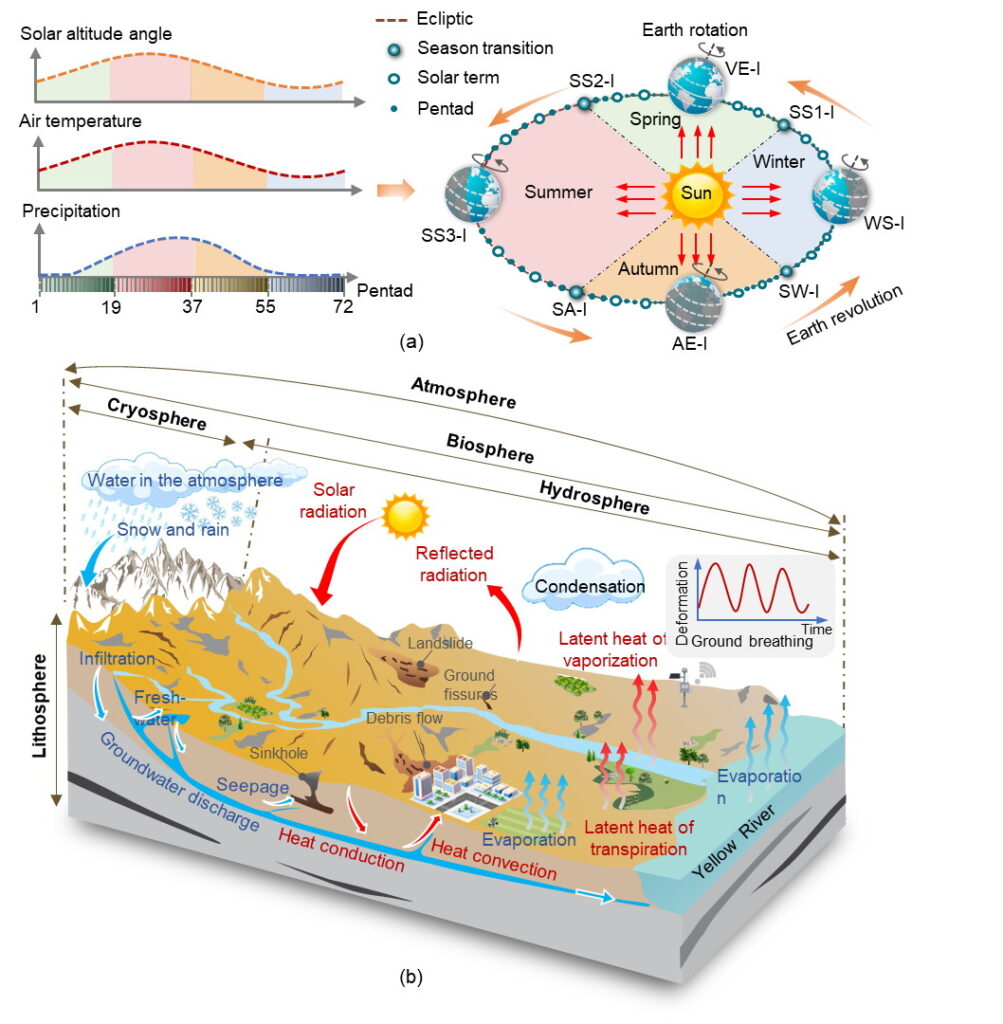
图1. 中国传统历法中的候划分及其对黄土高原地球主要圈层和地质灾害的影响
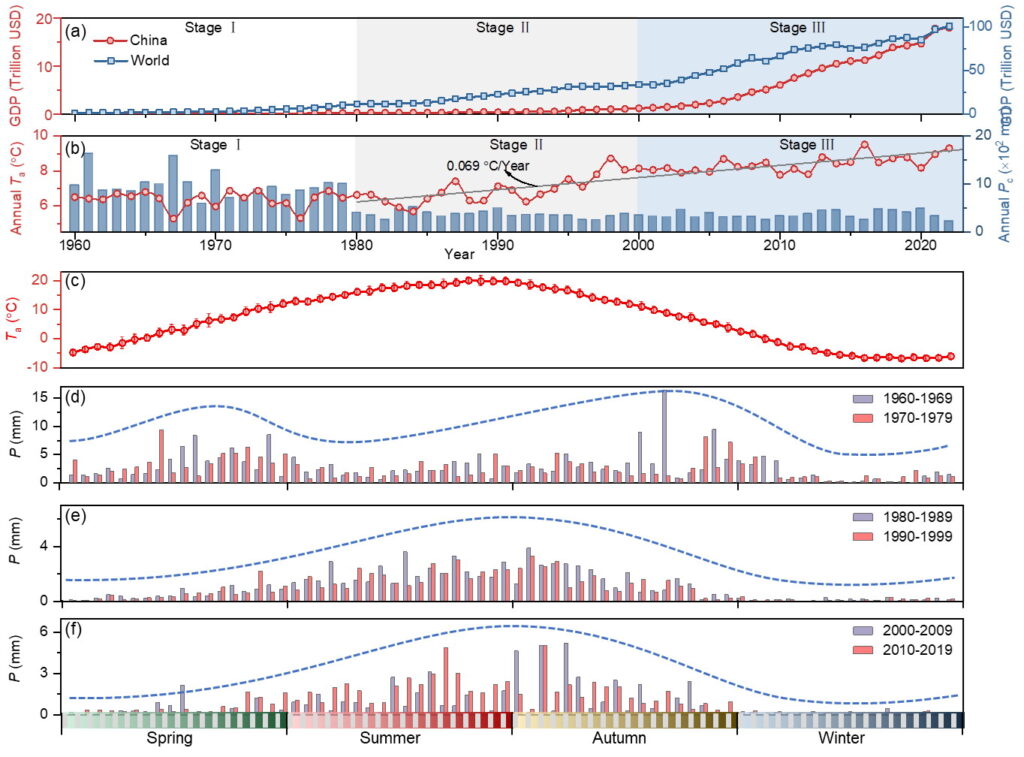
图2. 世界和中国的国内生产总值(GDP)趋势,以及1960年至2022年研究地点的历史气象数据
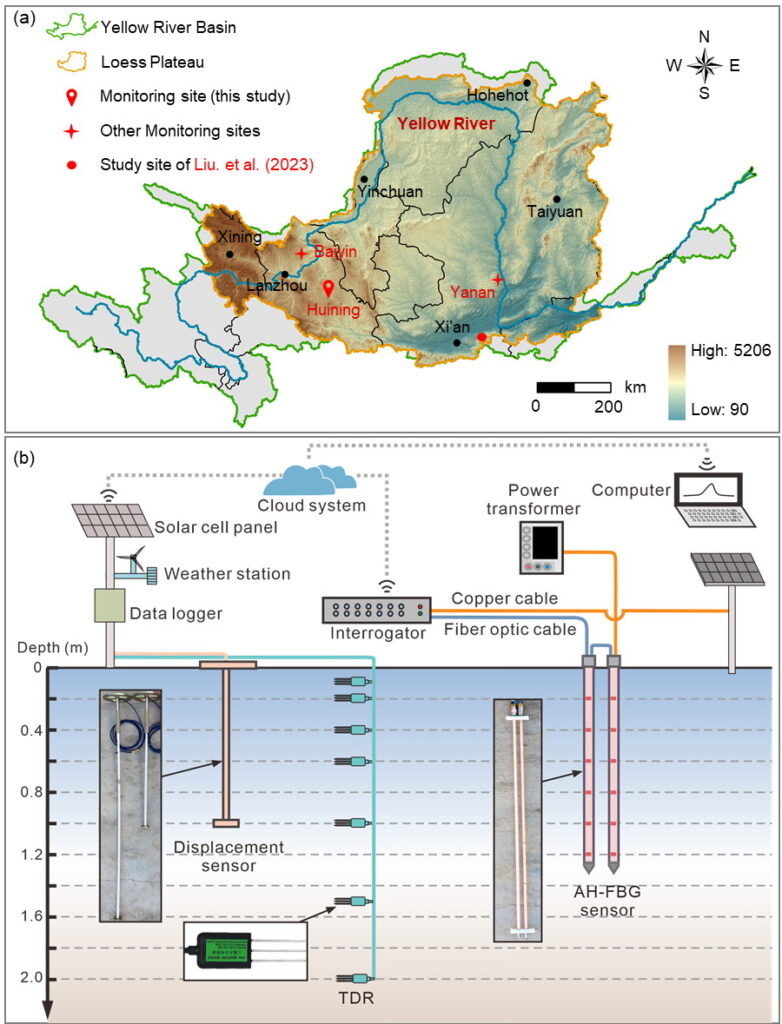
图3. 研究区和监测设置
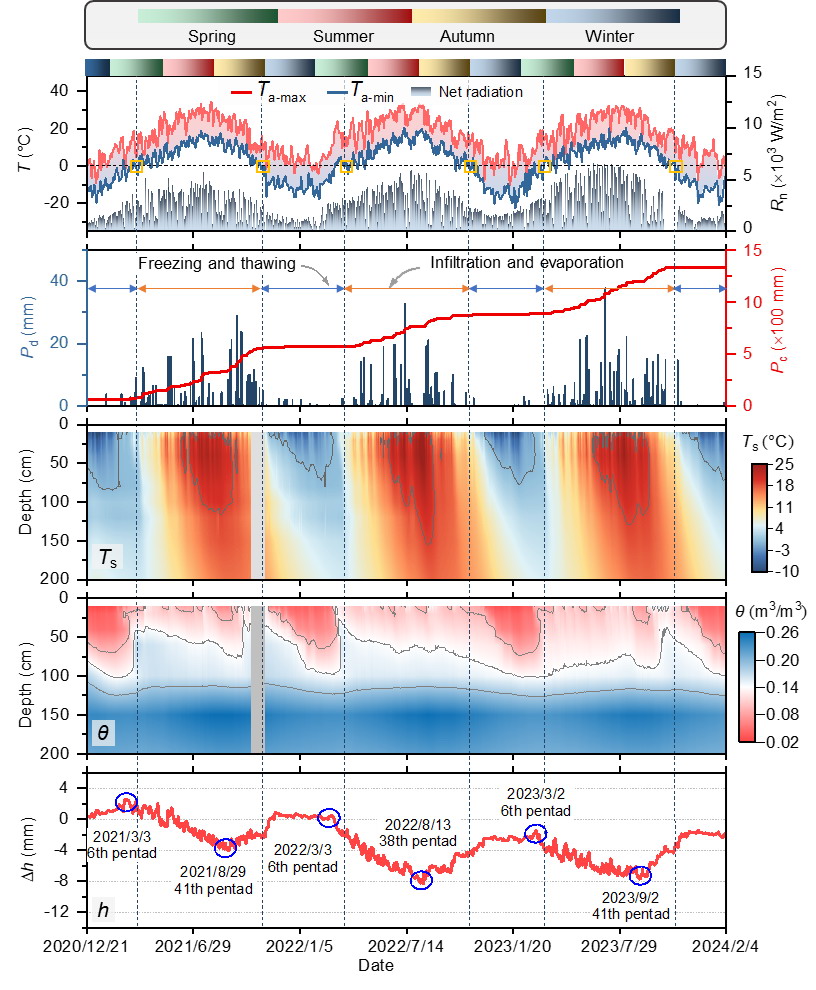
图4. 2021年至2023年,72候以下的日最高和最低气温(Ta max和Ta min)、日累积净辐射(Rn)、降水(P)、土壤温度(Ts)、土壤含水量(θ)和变形(Δh)的年变化
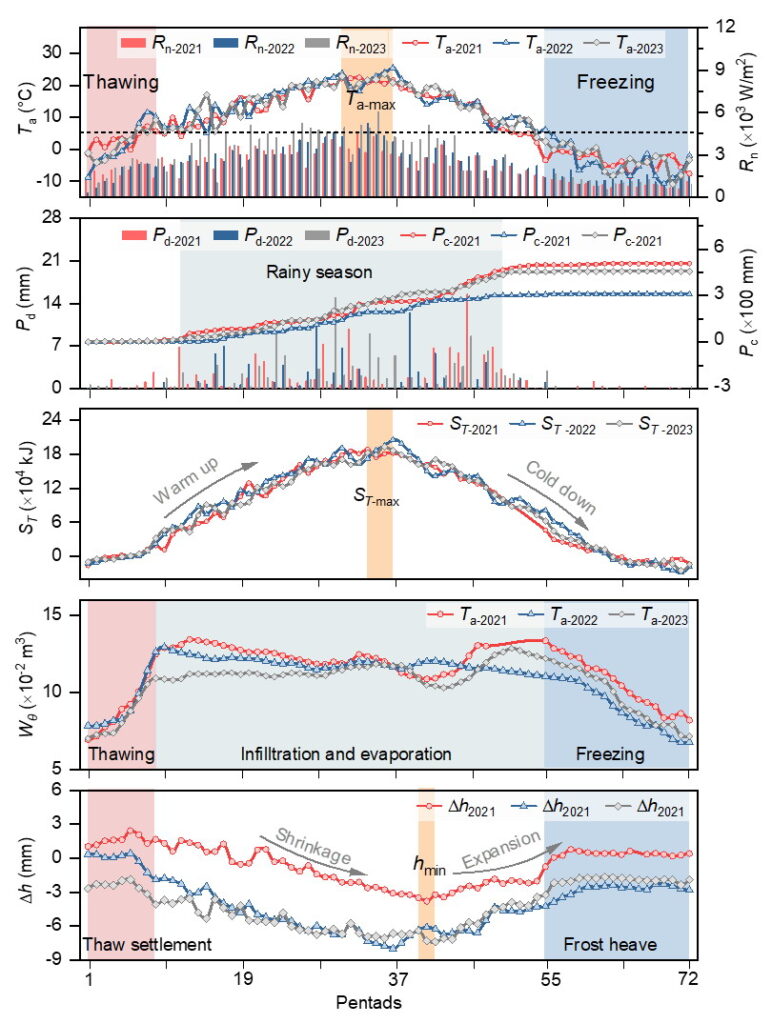
图5. 2021年、2022年和2023年72候的监测变量的时间特征
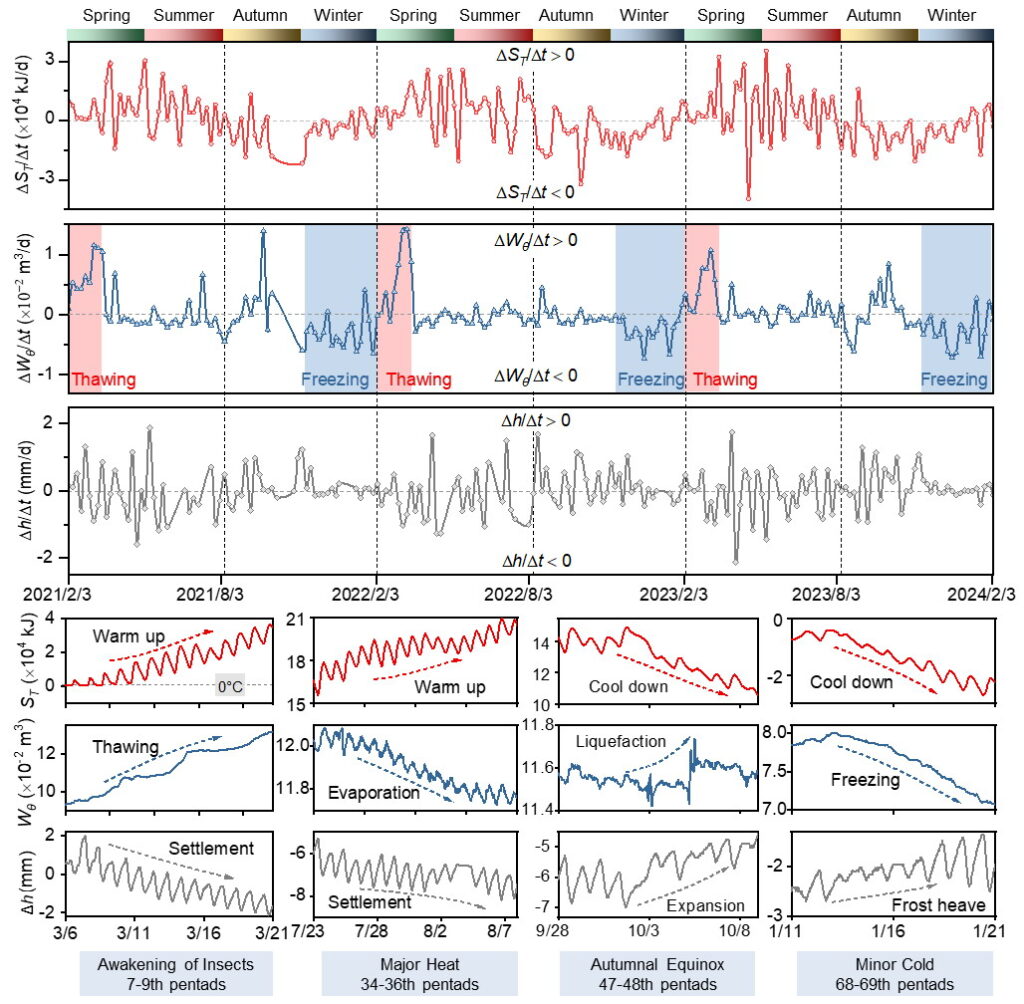
图6. 不同候(上图)土壤储热(ST)、储水(Wθ)和位移(Δh)日变化率的年变化率;2022年特定候点ST、Wθ和Δh的日变化(下图)
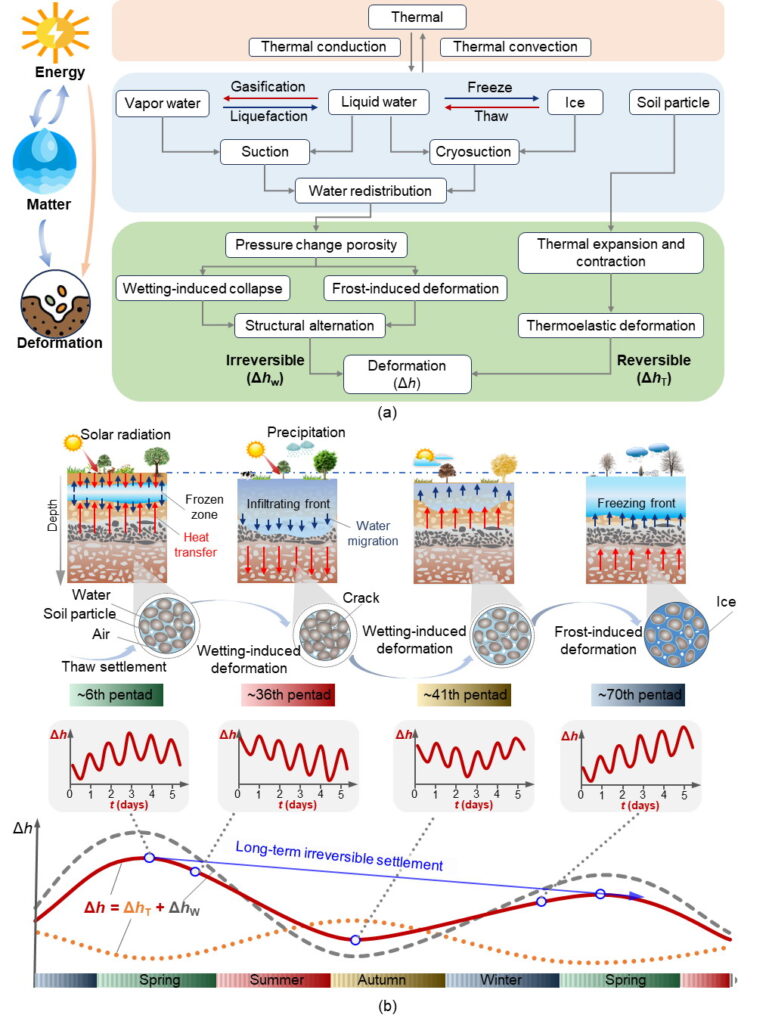
图7. 72候黄土能量传递和物质转化变形机制及趋势
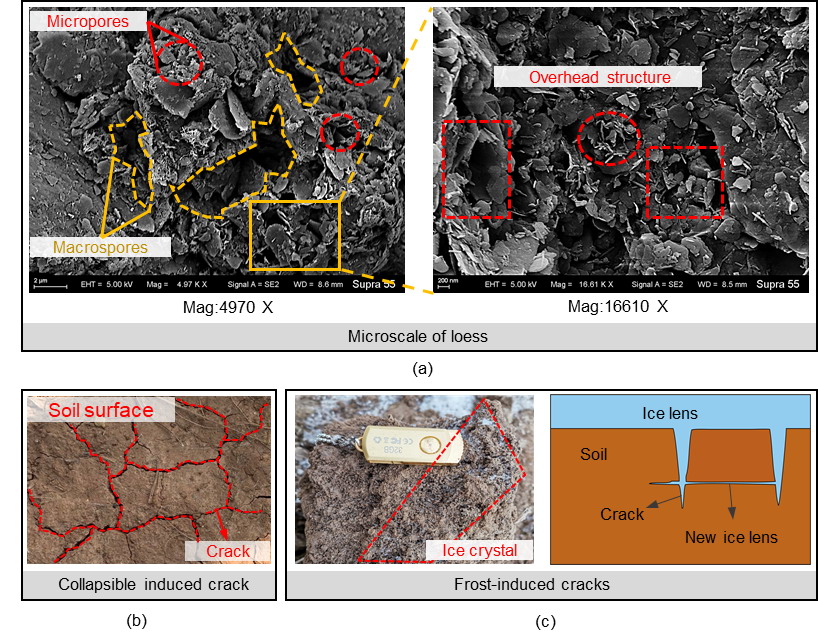
图8. (a)黄土的扫描电镜(SEM)图像;(b)坍塌引起的黄土表面裂缝照片;(c)显示冰晶的挖掘土壤照片和黄土内冰透镜的插图
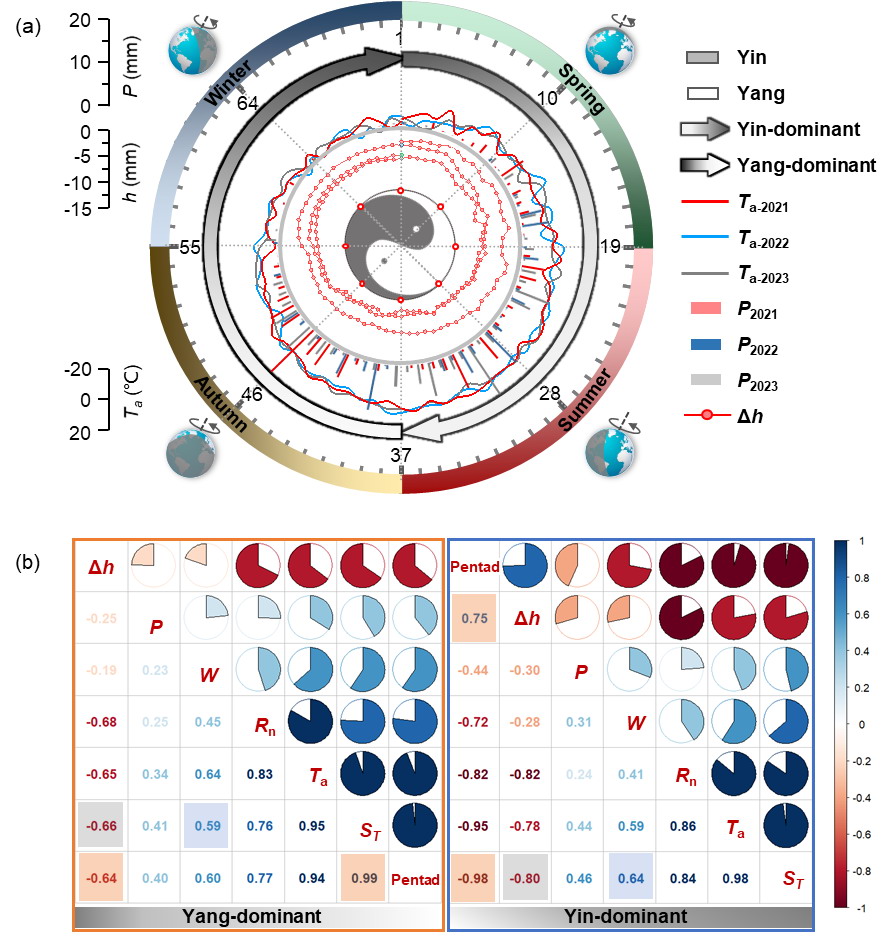
图9. 72候的地面呼吸动力学和阴阳转换
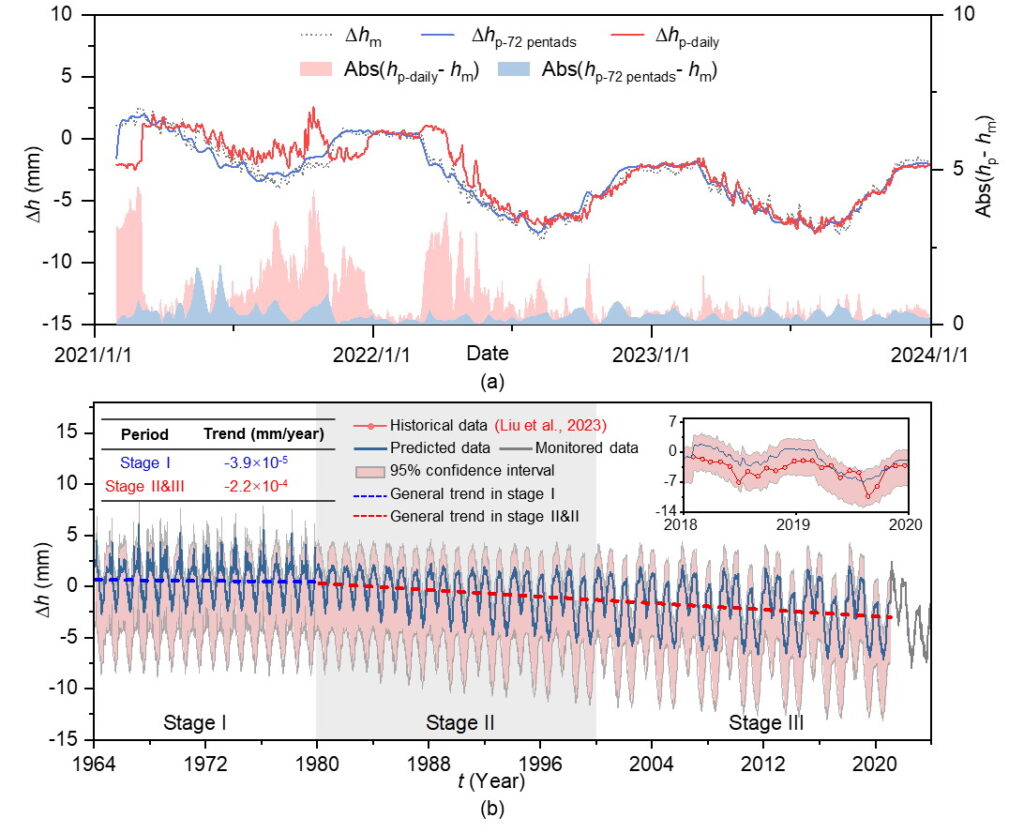
图10. 不同时间尺度下地面变形观测和预测的比较
【结论】本研究通过创新性地将中国古代历法知识(72候)与现代地质灾害监测技术相结合,研究了黄土高原黄土土壤的地面呼吸效应。主要发现总结如下:
1、通过三年的连续现场监测,首次清楚地确定了一种独特的地面呼吸变形模式,其特征是热诱导收缩和冷诱导膨胀。这种模式明显偏离了季节性冻土的传统热膨胀-收缩行为,揭示了黄土土壤对季节和日尺度气候波动的新的热水力响应。
2、定量区分了可逆和不可逆变形对地面呼吸效应的贡献。主要由土壤能量转移、水分再分配和相变过程驱动的不可逆变形累计约占28.4%。这种不可逆成分被确定为黄土土壤中观察到的长期沉降趋势的关键驱动因素。
3、通过引入传统的72候日历作为生态计时器,这项研究证明了它在捕捉与地面呼吸效应相关的土壤能量和物质的周期性变化方面的有效性。这种整合显著提高了我们解释和预测黄土中气候引起的土壤变形过程的能力。
4、利用72候框架,通过先进的LSTM建模方法成功重建了60年的历史地面变形趋势。重建的数据表明,由于气候变暖,不可逆变形逐渐累积,证实了72候系统与基于公历的模型相比具有实质性的预测优势。
本研究创新性地识别和阐明了黄土土壤中地面呼吸效应的独特机制——热诱导收缩和冷诱导膨胀。通过创造性地将传统的72候日历系统融入现代地质灾害评估方法中,本研究不仅深化了对气候引起的土壤变形的基本理解,而且为预测和减轻黄土和全球其他气候敏感地区未来的地质风险提供了一种新颖有效的方法。
标题:Ground-breathing effect of the Loess Plateau: Insights from the Chinese 72 pentads
中文翻译:黄土高原的地面呼吸效应:来自中国七十二候的启示
期刊:Journal of Rock Mechanics and Geotechnical Engineering
通讯作者:朱鸿鹄教授(南京大学 地球科学与工程学院)
原文链接:https://doi.org/10.1016/j.jrmge.2025.05.001
发表日期:2025-5-22
Wu, B., Zhu, H.-H.*, Wang, D., Wang, C., Zhang, W., Pasuto, A., Catani, F., 2026. Ground-breathing effect of the Loess Plateau: Insights from the Chinese 72 pentads. Journal of Rock Mechanics and Geotechnical Engineering, online.
References
Alam S., Vishwakarma G.K. Prediction of InSAR deformation time-series using improved LSTM deep learning model. Sci. Rep. 2025;15:5333.
Awais M., Mahum R., Zhang H., Zhang W., Mohammed A.S.M., Hu J., Arshad I. Shortterm photovoltaic energy generation for solar powered high efficiency irrigation systems using LSTM with spatio-temporal attention mechanism. Sci. Rep. 2024;14: 10042.
ASTM D2487–17. Standard Practice for Classification of Soils for Engineering Purposes (Unified Soil Classification System). West Conshohocken, USA: ASTM International; 2017.
Bai R., Lai Y., Zhang M., Jiang H. Investigating the thermo-hydro-mechanical behavior of loess subjected to freeze–thaw cycles. Acta Geotech 2024;19:6305–18.
Berg A., Sheffield J., Milly P.C.D. Divergent surface and total soil moisture projections under global warming. Geophys. Res. Lett. 2017;44(1):236–44.
Bhuyan K., Rana K., Ferrer J.V., Cotton F., Ozturk U., Catani F., Malik N. Landslide topology uncovers failure movements. Nat. Commun. 2024;15(1):2633.
Chen H., Lee C.F. A dynamic model for rainfall-induced landslides on natural slopes. Eng. Geol. 2003;51(4):269–88.
Chen X., Liao Y., Li Y. Following the rhythm of nature: wisdom in the 24 solar terms and the 12 constellations. In: Zhou G., Li Y., Luo J., editors. Science Education and International Cross-Cultural Reciprocal Learning. Intercultural Reciprocal Learning in Chinese and Western Education. Cham, Switzerland: Palgrave Macmillan; 2023. p.11–26.
Collins B.D., Stock G.M. Rockfall triggering by cyclic thermal stressing of exfoliation fractures. Nat. Geosci. 2016;9:395–400.
Cui P., Peng J., Shi P.J., et al. Scientific challenges of research on natural hazards and disaster risk. Geogr. Sustain. 2021;2(3):216–23.
Davarzani H., Smits K., Tolene R.M., Illangasekare T. Study of the effect of wind speed on evaporation from soil through integrated modeling of the atmospheric boundary layer and shallow subsurface. Water Resour. Res. 2014;50:661–80.
Derbyshire E. Geological hazards in loess terrain, with particular reference to the loess regions of China. Earth Sci. Rev. 2001;54(1):231–60.
Ding Y.J., Mu C.C., Wu T.H., et al. Increasing cryospheric hazards in a warming climate. Earth Sci. Rev. 2021;213:103500.
Fang N.F., Zeng Y., Ran L.S., et al. Substantial role of check dams in sediment trapping and carbon sequestration on the Chinese Loess Plateau. Commun. Earth Environ. 2023;4(1):1–10.
Feng L., Zhang M.S., Jin Z., et al. The genesis, development and evolution of original vertical joints in loess. Earth Sci. Rev. 2021;214:103526.
Gou Q., Zhu Q. Response of deep soil moisture to different vegetation types in the Loess Plateau of northern Shannxi, China. Sci. Rep. 2021;11:15098.
Gunzburger Y., Merrien-Soukatchoff V., Guglielmi Y. Influence of daily surface temperature fluctuations on rock slope stability: case study of the Rochers de Valabres slope (France). Int. J. Rock Mech. Min. Sci. 2005;42(3):331–49.
Hayashi M. The cold vadose zone: Hydrological and ecological significance of frozen-soil processes. Vadose Zone J. 2013;13(1):1–8.
Hu X., Xue L., Yu Y.T., Guo S.F., Cui Y.F., Li Y., Qi S.W. Remote sensing characterization of mountain excavation and city construction in Loess Plateau. Geophys. Res. Lett. 2021;48(21):e2021GL095230.
Huang L.M., Shao M.A. Advances and perspectives on soil water research in China’s Loess Plateau. Earth Sci. Rev. 2019;199:102962.
Huang X.M., Miao X.D., Chang Q.F., et al. Tibetan dust accumulation linked to ecological and landscape response to global climate change. Geophys. Res. Lett. 2022a;49(1): e2021GL096615.
Huang Y.S., Chiu J.M., Lin C.Y., Robin. The effect of Chinese lunar calendar on individual investors’ trading. Pac.-Basin Financ. J. 2022b;71:101694.
Huggett R., Colina F.D., Delgado-Iniesta M.J. Edaphosphere: a perspective of soil inside the biosphere. Earth 2023;4(36):691–7.
Kruse G., Dijkstra T., Schokking F. Effects of soil structure on soil behaviour: illustrated with loess, glacially loaded clay and simulated flaser bedding examples. Eng. Geol. 2007;91(1):34–45.
Lan H., Zhao X., Macciotta R., et al. The cyclic expansion and contraction characteristics
of a loess slope and implications for slope stability. Sci. Rep. 2021;11(1):2250.
Lahsen M., Ribot J. Politics of attributing extreme events and disasters to climate change.
WIREs Clim. Chang. 2022;13(1):e750.
Lawler A. Beyond the Yellow River: how China became China. Science 2009;325(5943): 945.
Li P., Vanapalli S., Li T.L. Review of collapse triggering mechanism of collapsible soils due to wetting. J. Rock Mech. Geotech. Eng. 2016;8(2):256–74.
Li G., Wang F., Ma W., Fortier R., Mu Y., Mao Y., Hou X. Variations in strength and deformation of compacted loess exposed to wetting-drying and freeze-thaw cycles. Cold Reg. Sci. Tech. 2018;151:159–67.
Li Y., Shi W., Aydin A., Beroya-Eitner M.A., Gao G. Loess genesis and worldwide distribution. Earth Sci. Rev. 2020;201:102947.
Liu S., Wang Y., An Z., et al. Watershed spatial heterogeneity of soil saturated hydraulic conductivity as affected by landscape unit in the critical zone. Catena (Cremling.) 2021;203:105322.
Liu X., Ma C., Ling H., Yan W.T., Zhang H.B., Jiang X.H. Analysis of land subsidence caused by hydrodynamic force in Loess Hilly and gully region based on SBAS-InSAR. PLoS One 2023;18(1):e0279832.
Ma W., Mu Y., Wu Q., Sun Z., Liu Y. Characteristics and mechanisms of embankment deformation along the Qinghai-Tibet Railway in permafrost regions. Cold Reg. Sci. Technol. 2011;67(3):178–86.
Mi Z., Sun X. Provinces with transitions in industrial structure and energy mix performed best in climate change mitigation in China. Commun. Earth Environ. 2021;2(1):182.
Nie Y., Ni W., Lü X., Tuo W. Exploring the mechanical behavior and microstructure of compacted loess subjected to dry-wet cycles and chemical contamination. J. Rock Mech. Geotech. Eng. 2024;16:3673–95.
Nylan M. The Five “Confucian” Classics. New Haven, USA: Yale University Press; 2001. Peng X., Wang Y., Heitman J., Ochsner T., Horton R., Ren T. Measurement of soilsurface heat flux with a multi-needle heat-pulse probe. Eur. J. Soil Sci. 2017;68(3): 336–44.
Peng J., Wang S., Wang Q., et al. Distribution and genetic types of loess landslides in China. J. Asian Earth Sci. 2019;170:329–50.
Qian C., Yan Z.W., Fu C.B. Climatic changes in the twenty-four solar terms during 1960–2008. Chin. Sci. Bull. 2011;57(2):276–86.
Shi Y., Ma W., Zhang L., Yang C., Shang F., Chen C. Change of pore water near the freezing front during soil freezing: migration and mechanism. Pedosphere 2023;34 (4):770–82.
Stocker T.F., Qin D., Plattner G.K., et al. Climate Change 2013: the Physical Science