
摘要:地下剪切波速的分布通常用于评估土壤液化和地震放大效应的潜力,以及对地震场地进行分类。新开发的分布式声学传感(DAS)技术能够作为高密度地震观测系统来估计剪切波分布。该技术的特点是低维护成本、高分辨率输出和实时数据传输能力,尽管存在管理海量数据生成的挑战。快速高效的数据解释是推进DAS技术应用的关键。在这项研究中,作者们进行了现场测试,使用DAS技术在短时间内记录环境噪声,从中提取表面波频散曲线。为了减小方向效应对结果的影响,采用无监督聚类方法选择合适的聚类提取格林函数。提出了一种遗传算法和蒙特卡罗(GA-MC)模拟相结合的方法来反演地下速度结构。GA-MC法获得的地层剖面与钻孔剖面一致。与其他方法相比,所提出的优化方法不仅提高了求解质量,而且减少了求解时间。
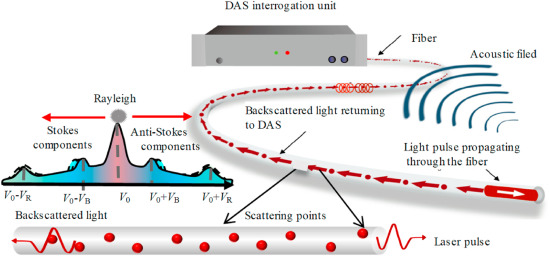
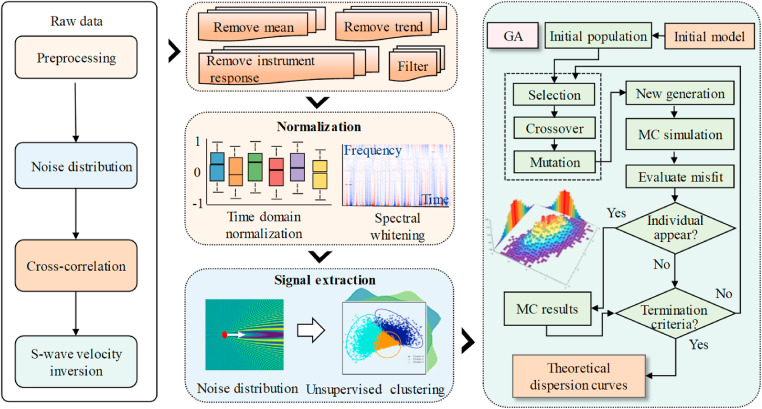
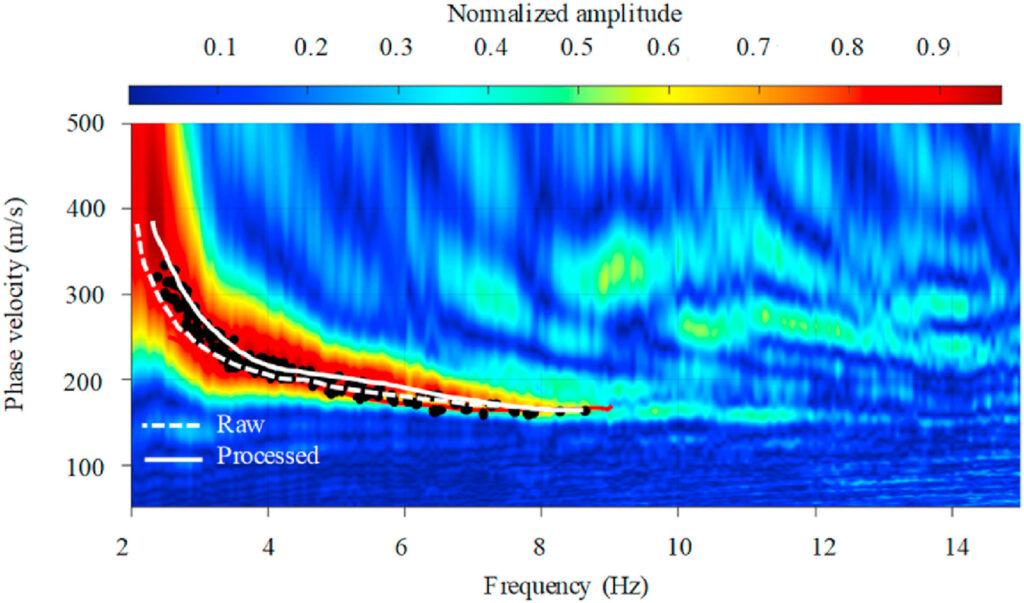
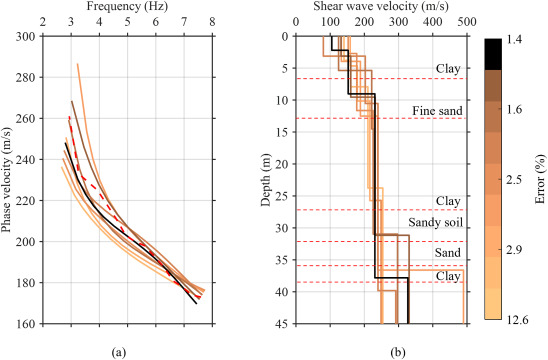
南京大学朱鸿鹄教授团队在《Journal of Rock Mechanics and Geotechnical Engineering》上发表了题为“Enhancing subsurface seismic profiling with distributed acoustic sensing and optimization algorithms”的研究成果,博士研究生王静为第一作者。该研究在无锡市开展,布设了一条长约160米、道间距4米、标距10米的自埋光缆,利用约2小时的背景噪声数据进行测试。研究采用相移法提取频散曲线,针对DAS技术的方向敏感特性和背景噪声源方向性影响,创新性地运用聚类算法挑选噪声源,减少了方向效应对频散曲线提取的干扰。此外,研究结合遗传算法和蒙特卡洛算法进行反演,显著提升了求解速度和质量。这项工作不仅验证了DAS技术在地下结构检测中的可行性,还通过优化算法提高了数据处理效率,为城市地质灾害监测和地下资源勘探提供了新的技术手段。该研究得到了国家杰出青年科学基金项目和国家自然科学基金面上项目的资助。
标题:Enhancing subsurface seismic profiling with distributed acoustic sensing and optimization algorithms
来源:Journal of Rock Mechanics and Geotechnical Engineering, 17(6), 3632-3643.
作者:Jing Wang a, Hong-Hu Zhu a, b *, Gang Cheng a, c, Tao Wang a, Xu-Long Gong d, Dao-Yuan Tan a **, Bin Shi a
单位:a. School of Earth Sciences and Engineering, Nanjing University, Nanjing, 210023, China;
b. Nanjing University High-Tech Institute at Suzhou, Suzhou, 215123, China;
c. School of Computer Science, North China Institute of Science and Technology, Beijing, 101601, China;
d. Key Laboratory of Earth Fissures Geological Disaster, Ministry of Natural Resources (Geological Survey of Jiangsu Province), Nanjing, 210018, China
Abstract: The distribution of shear-wave velocities in the subsurface is generally used to assess the potential for seismic liquefaction and soil amplification effects and to classify seismic sites. Newly developed distributed acoustic sensing (DAS) technology enables estimation of the shear-wave distribution as a high-density seismic observation system. This technology is characterized by low maintenance costs, high-resolution outputs, and real-time data transmission capabilities, albeit with the challenge of managing massive data generation. Rapid and efficient interpretation of data is the key to advancing application of the DAS technology. In this study, field tests were carried out to record ambient noise over a short period using DAS technology, from which the surface-wave dispersion curves were extracted. In order to reduce the influence of directional effects on the results, an unsupervised clustering method is used to select appropriate clusters to extract the Green’s function. A combination of a genetic algorithm and Monte Carlo (GA-MC) simulation is proposed to invert the subsurface velocity structure. The stratigraphic profiles obtained by the GA-MC method are in agreement with the borehole profiles. Compared to other methods, the proposed optimization method not only improves the solution quality but also reduces the solution time.
Keywords: Shallow subsurface velocity, Site classification, Ambient noise imaging, Distributed acoustic sensing (DAS), Genetic algorithms and Monte Carlo simulation.
References
Ajo-Franklin, J.B., Dou, S., Lindsey, N.J., Monga, I., Tracy, C., Robertson, M., Tribaldos, V.R., Ulrich, C., Freifeld, B., Daley, T., 2019. Distributed acoustic sensing using dark fiber for near-surface characterization and broadband seismic event detection. Sci. Rep. 9 (1), 1328-1346.
Amaran, S., Sahinidis, N.V., Sharda, B., and Bury, S.J., 2016. Simulation optimization: a review of algorithms and applications. Ann. Oper. Res. 240, 351-380.
Babaee, E., Anuar, N.B., Abdul Wahab, A.W., Shamshirband, S., and Chronopoulos, A.T., 2017. An overview of audio event detection methods from feature extraction to classification. Appl. Artif. Intell. 31 (9-10), 661-714.
Beaty, K.S., Schmitt, D.R., Sacchi, M., 2002. Simulated annealing inversion of multimode Rayleigh wave dispersion curves for geological structure. Geophys. J. Int. 151, 622–631.
Bensen, G.D., Ritzwoller, M.H., Barmin, M.P., Levshin, A.L., Lin, F., Moschetti, M., Shapiro, N., Yang, Y., 2007. Processing seismic ambient noise data to obtain reliable broad-band surface wave dispersion measurements. Geophys. J. Int. 169 (3), 1239-1260.
Brocher, T.M., 2005. Empirical relations between elastic wavespeeds and density in the Earth’s crust. Bull. Seismol. Soc. Am. 95 (6), 2081-2092.
Chen, Y., Chen, L.S., Yu, S., 2003. Urban Geophysics: A new discipline of Earth science. J. Geod. Geodyn. 23 (4), 1-4 (in Chinese).
Chen, Y.K., 2024. Recovering signal from noise in distributed acoustic sensing data processing. Seismol. Res. Lett. https://pubs.geoscienceworld.org/ssa/srl/article-abstract/95/3/1976/637015/SigRecover-Recovering-Signal-from-Noise-in
D’Angelo, G., and Palmieri, F., 2021. GGA: A modified genetic algorithm with gradient-based local search for solving constrained optimization problems. Inform. Sciences 547, 136-162.
Dadashpoor, H., Malekzadeh, N., 2020. Driving factors of formation, development, and change of spatial structure in metropolitan areas: A systematic review. J. Urban Manag. 9 (3), 286-297.
Dal Moro, G., Pipan, M., Gabrielli, P., 2007. Rayleigh wave dispersion curve inversion via genetic algorithms and marginal posterior probability density estimation. J. Appl. Geophys. 61 (1), 39–55.
Daley, T.M., Freifeld, B.M., Ajo-Franklin, J., Dou, S., Pevzner, R., Shulakova, V., Kashikar, S., Miller, D.E., Goetz, J., Henninges, J., 2013. Field testing of fiber-optic distributed acoustic sensing (DAS) for subsurface seismic monitoring. Lead. Edge 32 (6), 699-706.
Duan, W., Zhao, Z., Cai, G., Wang, A., Wu, M., Dong, X., Liu, S., 2023. Vs-based assessment of soil liquefaction potential using ensembling of GWO–KLEM and Bayesian theorem: A full probabilistic design perspective. Acta Geotech. 18 (4), 1863–1881.
Foti, S., Parolai, S., Albarello, D., et al., 2011. Application of surface-wave methods for seismic site characterisation. Surv. Geophys. 32 (6), 777-825.
Foti, S., Lai, C.G., Rix, G.J., and Strobbia, C., 2015. Surface wave methods for near-surface site characterization. CRC Press, Taylor & Francis Group, Boca Raton, Fla.
Kausel, E., Roësset, J.M., 1981. Stiffness matrices for layered soils. Bull. Seismol. Soc. Am. 71 (6), 1743–1761.
Kim, N., Park, G., Kim, S.Y., Lee, J.S., Park, J., 2023. Physics-inspired geophysical assessment of liquefaction potential in Pohang, South Korea. Acta Geotech. 1-15.
Kramer, S.L., 1996. Geotechnical earthquake engineering. Prentice-Hall, Inc., Upper Saddle River, N.J.
Kumar, R.R., Reddy, M.B., Praveen, P., 2017. A review of feature subset selection on unsupervised learning. Third International Conference on Advances in Electrical, Electronics, Information, Communication and Bio-Informatics (AEEICB) (Chennai) 163-167.
Lai, Y., Wang, Y., Cheng, J., Chen, X., Liu, Q., 2023. Review of constraints and critical success factors of developing urban underground space. Undergr. Space 12, 137-155.
Lin, R.B., Zeng, X.F., Song, Z.H., et al., 2020. Distributed acoustic sensing for imaging shallow structure II: Ambient noise tomography. Chinese J. Geophys. 63 (4), 1622-1629.
Ma, H., Zhou, S., Wang, Y., Wu, N., Li, Y., and Tian, Y., 2024. Improving distributed acoustic sensing data quality with self-supervised learning. IEEE Geosci. Remote Sens. Lett. 21, 1-5.
Ma, J., Pei, H., Zhu, H., Shi, B., Yin, J., 2023. A review of previous studies on the applications of fiber optic sensing technologies in geotechnical monitoring. Rock Mech. Bull. 2 (1), 100021.
Mateeva, A., Mestayer, J., Cox, B., et al., 2012. Advances in distributed acoustic sensing (DAS) for VSPs. SEG Tech. Prog. Exp. Abstr., SEG 1-5.
Mikhaltsevitch, V., Lebedev, M., Pevzner, R., et al., 2023. Low-frequency laboratory measurements of the elastic properties of solids using a distributed acoustic sensing system. J. Rock Mech. Geotech. Eng. 15 (9), 2330-2338.
Mjehovich, J., Jin, G., Martin, Eileen R., Shragge, J., 2023. Rapid surface deployment of a DAS system for earthquake hazard assessment. J. Geotech. Geoenviron. Eng. 149 (5), 04023027.
Olafsdottir, E.A., Erlingsson, S., Bessason, B., 2018. Tool for analysis of multichannel analysis of surface waves (MASW) field data and evaluation of shear wave velocity profiles of soils. Can. Geotech. J. 55 (2), 217-233.
Otchere, D. A., Ganat, T. O. A., Nta, V., Brantson, E. T., and Sharma, T., 2022. Data analytics and Bayesian Optimised Extreme Gradient Boosting approach to estimate cut-offs from wireline logs for net reservoir and pay classification. Appl. Soft. Comput. 120, 108680.
Otchere, D.A., Latiff, A.H., and Tackie-Otoo, B.N., 2024. Distributed acoustic sensing in subsurface applications–Review and potential integration with artificial intelligence for an intelligent CO2 storage monitoring system. Geoenergy Sci. Eng. 212818.
Sabra, K.G., Gerstoft, P., Roux, P., Kuperman, W., Fehler, M.C., 2005. Surface wave tomography from microseisms in Southern California. Geophys. Res. Lett. 32 (14), 1-4.
Sambridge, M., Mosegaard, K., 2002. Monte Carlo methods in geophysical inverse problems. Rev. Geophys. 40 (3), 1009.
Shapiro, N.M., Campillo, M., Stehly, L., Ritzwoller, M.H., 2005. High-resolution surface-wave tomography from ambient seismic noise. Science 307 (5715), 1615-1618.
Shatalin, S., Parker, T., and Farhadiroushan, M., 2021. High definition seismic and microseismic data acquisition using distributed and engineered fiber optic acoustic sensors. Distributed Acoustic Sensing in Geophysics: Methods and Applications; Wiley: Hoboken, USA 1–32. https://agupubs.onlinelibrary.wiley.com/doi/10.1002/9781119521808.ch1.
Shi, B., Wang, B., Zhang, C., Gu, K., Ruan, Y., Li, G., Wang, Q., Wei, G., Zhang, D., Zhu, H.-H., et al., 2022. Multi-physical distributed fiber optic observation in a 3211-m-deep scientific borehole at Jiajika lithium mine, western Sichuan. Chin. Sci. Bull. 67, 2719–2726. (in Chinese)
Siebenmann, R., Yu, H.-T., Bachus, R., 2015. UCIMS: Advances in geotechnical construction and performance monitoring. J. Rock Mech. Geotech. Eng. 7 (2), 207-212.
Song, Z.H., Zeng, X.F., Xu, S. H., et al., 2020. Distributed Acoustic Sensing for imaging shallow structure I: Active source survey. Chinese J. Geophys. 63 (2), 532-540.
Song, Z., Zeng, X., Xie, J., Bao, F., and Zhang, G., 2021. Sensing shallow structure and traffic noise with fiber-optic internet cables in an urban area. Surv. Geophys. 42, 1401-1423.
Soupios, P., Akca, I., Mpogiatzis, P., Basokur, A.T., Papazachos, C., 2011. Applications of hybrid genetic algorithms in seismic tomography. J. Appl. Geophys. 75 (3), 479–489.
Tribaldos, V.R., Ajo-Franklin, J.B., 2021. Aquifer monitoring using ambient seismic noise recorded with distributed acoustic sensing (DAS) deployed on dark fiber. J. Geophys. Res. Solid Earth 126, e2020JB021004.
Van den Ende, M., Lior, I., Ampuero, J. P., Sladen, A., Ferrari, A., and Richard, C., 2021. A self-supervised deep learning approach for blind denoising and waveform coherence enhancement in distributed acoustic sensing data. IEEE Trans. Neural Networks Learn. Syst. 34 (7), 3371-3384.
Wang, K., Luo, Y., Yang, Y., 2016. Correction of phase velocity bias caused by strong directional noise sources in high-frequency ambient noise tomography: a case study in Karamay, China. Geophys. J. Int. 205 (2), 715-727.
Willis, M.E., 2022. Distributed acoustic sensing for seismic measurements what geophysicists and engineers need to know. Society of Economic Geologists.
Willis, M. E., Ellmauthaler, A., Wu, X., and LeBlanc, M. J. 2021. Important aspects of acquiring distributed acoustic sensing (DAS) data for geoscientists. Distributed Acoustic Sensing in Geophysics: Methods and Applications 33-44. https://agupubs.onlinelibrary.wiley.com/doi/10.1002/9781119521808.ch2.
Wuestefeld, A., Spica, Z.J., Aderhold, K., Huang, H.-H., Ma, K.-F., Lai, V.H., Miller, M., Urmantseva, L., Zapf, D., Bowden, D.C., et al., 2023. The global DAS month of February 2023. Seismol. Res. Lett. 1–9.
Xia, J., Miller, R.D., and Park, C.B., 1999. Estimation of near-surface shear-wave velocity by inversion of Rayleigh waves. Geophys. 64 (3), 691–700.
Xia, J.H., Miller, R.D., Park, C.B., Tian, G., 2003. Inversion of high frequency surface waves with fundamental and higher modes. J. Appl. Geophys. 52 (1), 45–57.
Xie, Y., Wang, M., Zhong, Y., Deng, L., and Zhang, J., 2023. Label-free anomaly detection using distributed optical fiber acoustic sensing. Sensors 23 (8), 4094.
Yan, Y., Chen, X., Huai, N., Guan, J., 2022. Modern inversion workflow of the multimodal surface wave dispersion curves: Staging strategy and Pattern search with embedded Kuhn–Munkres algorithm. Geophys. J. Int. 231 (1), 47–71.
Yang, L., Fomel, S., Wang, S., Chen, X., and, Chen, Y., 2023. Unsupervised learning framework for denoising distributed acoustic sensing (DAS) data. 84th EAGE Annual Conf. & Exhib., Eur. Assoc. Geosci. Eng. (1), 1-5.
Ye, X., Zhu, H.H., Chang, F.N., Xie, T.C., Tian, F., Zhang, W., Catani, F., 2024. Revisiting spatiotemporal evolution process and mechanism of a giant reservoir landslide during weather extremes. Eng. Geol. 332, 107480.
Yin, J., 2017. Study on the quaternary stratigraphy refinement analysis and ground subsidence mechanism in Wuxi ground subsidence zone. Master’s thesis, Nanjing University (in Chinese).
Yuan, S., Lellouch, A., Clapp, R.G., Biondi, B., 2020. Near-surface characterization using a roadside distributed acoustic sensing array. Lead. Edge 39 (9), 646-653.
Zeng, C., Liu, Y.L., Stein, A., Jiao, L.M., 2015. Characterization and spatial modelling of urban sprawl in the Wuhan Metropolitan Area, China. Int. J. Appl. Earth Obs. Geoinf. 34, 10-24.
Zeng, X., Lancelle, C., Thurber, C., Fratta, D., Wang, H., Lord, N., Chalari, A., Clarke, A., 2017. Properties of noise cross-correlation functions obtained from a distributed acoustic sensing array at Garner Valley, California. Bull. Seismol. Soc. Am. 107 (2), 603-610.
Zhao, Y., Li, Y., 2020. On beamforming of ambient noise recorded by DAS. In: SEG Tech. Prog. Exp. Abstr., Soc. Explor. Geophys. 515–519.
Zhu, H.-H., Liu, W., Wang, T., Su, J.-W., Shi, B., 2022. Distributed acoustic sensing for monitoring linear infrastructures: Current status and trends. Sensors 22, 7550.
引用格式:Wang, J.,Zhu, H.-H.*, Cheng, G., et al. (2025).Enhancing subsurface seismic profiling with distributed acoustic sensing and optimization algorithms. Journal of Rock Mechanics and Geotechnical Engineering, 17(6), 3632-3643.